Truth News Headlines July 14, 2018 – American Intelligence Media
Truth News Headlines July 14, 2018
— Read on aim4truth.org/2018/07/14/truth-news-headlines-july-14-2018/
The best news
Truth News Headlines July 14, 2018
— Read on aim4truth.org/2018/07/14/truth-news-headlines-july-14-2018/
The best news
The USA Is In A Civil War
A few days ago, Jack D. Minzey,
sent what was to be the final chapter in the long line of books and treatises which he had written.
Jack went to be with the Lord,
Sunday, 8 April 2018.
Professionally, Jack was head of the
Department of Education at Eastern Michigan University as well as a prolific author of numerous books, most of which
were on the topic of Education and the Government role therein. His interest in Conservative Politics was
exceeded only by his intellectual ability.
This is the last of his works: Civil War
How do civil wars happen?
Two or more sides disagree on who runs
the country. And they can’t settle the question through
elections because they don’t even agree that elections are
how you decide who’s in charge. That’s the basic issue
here. Who decides who runs the country? When you hate each
other but accept the election results, you have a country.
When you stop accepting election results, you have a
countdown to a civil war.
The Mueller investigation is about
removing President Trump from office and overturning the
results of an election. We all know that. But it’s not the
first time they’ve done this. The first time a Republican
president was elected this century, they said he didn’t
really win. The Supreme Court gave him the election. There’s
a pattern here.
What do sure odds of the Democrats
rejecting the next Republican president really mean? It
means they don’t accept the results of any election that
they don’t win. It means they don’t believe that transfers
of power in this country are determined by elections.
That’s a civil war.
There’s no shooting. At least not
unless you count the attempt to kill a bunch of Republicans
at a charity baseball game practice. But the Democrats have
rejected our system of government.
This isn’t dissent. It’s not
disagreement. You can hate the other party. You can think
they’re the worst thing that ever happened to the country.
But then you work harder to win the next election. When you
consistently reject the results of elections that you don’t
win, what you want is a dictatorship. Your very own dictatorship.
The only legitimate exercise of power
in this country, according to Democrats, is its own.
Whenever Republicans exercise power, it’s inherently
illegitimate. The Democrats lost Congress. They lost the
White House. So what did they do? They began trying to run
the country through Federal judges and bureaucrats. Every
time that a Federal judge issues an order saying that the
President of the United States can’t scratch his own back
without his say so, that’s the civil war.
Our system of government is based on
the constitution, but that’s not the system that runs this
country. The Democrat’s system is that any part of
government that it runs gets total and unlimited power over
the country.
If the Democrats are in the White
House, then the president can do anything. And I mean
anything. He can have his own amnesty for illegal aliens. He
can fine you for not having health insurance. His power is
unlimited. He’s a dictator.
But when Republicans get into the White
House, suddenly the President can’t do anything. He isn’t
even allowed to undo the illegal alien amnesty that his
predecessor illegally invented. A Democrat in the White
House has ‘discretion’ to completely decide every aspect of
immigration policy. A Republican doesn’t even have the
‘discretion’ to reverse him. That’s how the game is played
That’s how our country is run. Sad but true, although the
left hasn’t yet won that particular fight.
When a Democrat is in the White House,
states aren’t even allowed to enforce immigration law. But
when a Republican is in the White House, states can create
their own immigration laws. Under Obama, a state wasn’t
allowed to go to the bathroom without asking permission. But
under Trump, Jerry Brown can go around saying that
California is an independent republic and sign treaties with
other countries.
The Constitution has something to say
about that.
Whether it’s Federal or State,
Executive, Legislative or Judiciary, the left moves power
around to run the country. If it controls an institution,
then that institution is suddenly the supreme power in the
land. This is what I call a moving dictatorship.
Donald Trump has caused the Shadow
Government to come out of hiding: Professional government is
a guild. Like medieval guilds. You can’t serve in if you’re
not a member. If you haven’t been indoctrinated into its
arcane rituals. If you aren’t in the club. And Trump isn’t
in the club. He brought in a bunch of people who aren’t in
the club with him.
Now we’re seeing what the pros do when
amateurs try to walk in on them. They spy on them, they
investigate them and they send them to jail. They use the
tools of power to bring them down. That’s not a free country.
It’s not a free country when FBI agents
who support Hillary take out an ‘insurance policy’ against
Trump winning the election. It’s not a free country when
Obama officials engage in massive unmasking of the
opposition. It’s not a free country when the media responds
to the other guy winning by trying to ban the conservative
media that supported him from social media. It’s not a free
country when all of the above collude together to overturn
an election because the guy who wasn’t supposed to win did.
Have no doubt, we’re in a civil war
between conservative volunteer government and a leftist Democrat professional government.
–

I’ve spent several weeks explaining why I think excessive debt is dragging the world economy toward an epic crash. The tracks ahead are clear for now but will not remain so.
— Read on www.mauldineconomics.com/frontlinethoughts/the-debt-train-will-crash
It will
Here we go again. A fed official is once again going to the media to repeat the age-old myth that the Fed is totally independent of political influence. The last time we heard about this from someone at Powell’s level what last year, when Steve Mnuchin reminded everyone of the Fed’s alleged independence in January:
— Read on mises.org/power-market/feds-latest-claim-independence-unconvincing-ever
Truth News Headlines Evening July 13, 2018
— Read on aim4truth.org/2018/07/13/truth-news-headlines-evening-july-13-2018/
This weekend I joined a number of people for an online vigil in support of Wikileaks’ Julian Assange. Some have asked why I did it: after all, Assange is at best an imperfect figure. But supporting Assange transcends just him, because the battle over his prosecution is about something greater: the future of free speech and a free press. Even if you think Assange doesn’t matter, those things do.
Assange is challenging to even his staunchest supporters. In 2010, he was a hero to opponents of the wars in Iraq and Afghanistan, while others called him an enemy of the state for working with whistleblower Chelsea Manning. Now most of Assange’s former supporters see him as a traitor and a Putin tool for releasing emails from the Democratic National Committee. Even with the sexual assault inquiry against him having been dismissed, Assange is a #MeToo villain. He a traitor who hides from justice inside the Ecuadorian embassy in London, or a spy, or some web-made Frankenstein with elements of all the above. And while I’ve never met Assange, I’ve spoken to multiple people who know him well, and the words “generous,” “warm,” and “personable” are rarely included in their descriptions.
But none of that matters. What matters is that Assange has ended up standing at a crossroads in the history of our freedoms: specifically, at what point does the right of the people to know outweigh the right of the government to keep information from view? The question isn’t new, but it has become acute in the digital age, when physical documents no longer need to be copied one-by-one, can be acquired by hackers on the other side of the world, and are far removed from the traditions, obstacles, safeguards, and often-dangerous self-restraint of traditional journalism.
A complex history precedes Assange. In 1971, Daniel Ellsberg leaked the Pentagon Papers, a secret U.S. government-written history of the Vietnam War, to the New York Times. No one had ever published such classified documents before, and reporters at the Times feared they would go to jail under the Espionage Act. A federal court ordered the Times to cease publication after an initial flurry of excerpts were printed, the first time in U.S. history a federal judge had censored a newspaper. In the end, the Supreme Court handed down a victory for the First Amendment in New York Times Company v. United States, and the Times won the Pulitzer Prize.
But looking at the Times case through the lens of Wikileaks, law professor Steve Vladeck points out that
… although the First Amendment separately protects the freedom of speech and the freedom of the press, the Supreme Court has long refused to give any separate substantive content to the Press Clause above and apart from the Speech Clause…. The Supreme Court has never suggested that the First Amendment might protect a right to disclose national security information. Yes, the Pentagon Papers case rejected a government effort to enjoin publication, but several of the Justices in their separate opinions specifically suggested that the government could prosecute the New York Times and the Washington Post after publication, under the Espionage Act.
The Supreme Court left the door open for the prosecution of journalists who publish classified documents by focusing narrowly on prohibiting the government from exercising prior restraint. Politics and public opinion, not law, has kept the feds exercising discretion in not prosecuting the press, a delicate dance around an 800-pound gorilla loose in the halls of democracy. The government, meanwhile, has aggressively used the Espionage Act to prosecute whistleblowers who leak to those same journalists.
The closest a journalist ever came to being thrown in jail was in 2014, when the Obama administration subpoenaed New York Times reporter James Risen. They then accused former CIA officer Jeffrey Sterling of passing classified information to Risen, information that it said had appeared in his book State of War. After a lower court ordered Risen to testify and disclose his source under threat of jail, the Supreme Court turned down his appeal, siding with the government in a confrontation between a national security prosecution and an infringement of press freedom. The Supreme Court refused to consider whether there existed a gentlemen’s agreement under the First Amendment for “reporter’s privilege,” an undocumented protection beneath the handful of words in the Free Press Clause.
In the end, the government, fearful of setting the wrong precedent, punted on Risen. Waving the flag over a messy situation, then-attorney general Eric Holder announced that “no reporter who is doing his job is going to go to jail.” Risen wasn’t called to testify and wasn’t punished for publishing classified material, even as the alleged leaker, Jeffrey Sterling, disappeared into prison only to emerge three and a half years later in January. To avoid creating a precedent that might have granted some form of reporter’s privilege under the Constitution, the government stepped away from the fight.
Those same issues now hover over Julian Assange. Should the government decide to prosecute him, there are complex legal questions to be answered about who is a journalist and what is publishing in the digital world. There is no debate over whether James Risen is a journalist and whether a book is publishing. Glenn Greenwald has written about and published online classified documents given to him by Edward Snowden, and has never been challenged by the government as a journalist or publisher. Both men enjoy popular support and work for established media. The elements of fact checking, confirming, curating, redacting, and providing context around classified information were all present in the New York Times case with the Pentagon Papers; they are also present with American citizens Risen and Greenwald. Definitions and precedents may be forming.
Assange is an easier target. With him the government is able to mold the legal precedents with such certainty that, where they backed away from other cases in their long-running war of attrition against free speech and the press, this one they may seize.
Assange isn’t an American. He is unpopular, drawn now into America’s 21st-century Red Scare. He has written nothing alongside the millions of documents on Wikileaks, has done no curating or culling, and has redacted little. Publishing for him consists of uploading what has been supplied to him. The government could argue that Assange is not entitled to First Amendment protections simply by claiming that a mouse click isn’t publishing and Assange isn’t a journalist. The simplest interpretation of the Espionage Act, that Assange willfully transmittedinformation relating to national defense without authorization, would apply. He would be guilty, same as the other canaries in the deep mine shaft of Washington before him, no messy balancing questions to be addressed. And with that, a unique form of online journalism would be squashed.
And that really, really matters. Wikileaks does indeed sidestep the restraints of traditional journalism. In 2004, the New York Times held the story of George W. Bush’s illegal warrantless eavesdropping program until after his reelection. In 2006, the Los Angeles Times suppressed a story on the government’s wiretapping of Americans when asked to do so by the NSA. Glenn Greenwald said it plainly: too many journalists work in self-censoring mode, or “obsequious journalism,” as he called it. Meanwhile, Assange has made mistakes while broadly showing courage, not restraint, under similar circumstances. And the public is better informed because of it.
Wikileaks’ version of journalism says here are the cables, the memos, and the emails. Others can write about them (and nearly every mainstream media outlet has used Wikileaks to do that, some even while calling Assange a traitor), or you as a citizen can read the stuff yourself and make up your own damned mind. That is the root of an informed public, a set of tools never before available until Assange and the internet created them.
If Assange becomes the first successful prosecution of a third party under the Espionage Act, whether as a journalist or not, the government will turn that precedent into a weapon to attack the media’s role in any national security case. On the other hand, if Assange leaves London for asylum in Ecuador, that will empower new journalists to provide evidence when a government serves its people poorly and has no interest in being held accountable.
Freedom is never static. It either advances under our pressure, or recedes under theirs. I support Julian Assange.
Peter Van Buren, a 24-year State Department veteran, is the author of We Meant Well: How I Helped Lose the Battle for the Hearts and Minds of the Iraqi People and Hooper’s War: A Novel of WWII Japan. Follow him on Twitter @WeMeantWell
It’s paradise for US companies looking for cheap money. They range from sparkly investment-grade companies, such as Apple with its pristine balance sheet, to “junk” rated companies, such as Netflix with its cash-burn machine. They have all been doing it: Selling euro-denominated bonds in Europe.
The momentum for these “reverse Yankees” took off when the ECB’s Negative Interest Rate Policy and QE – which includes the purchase of euro bonds issued by European entities of US companies – pushed yields of many government bonds and some corporate bonds into the negative.
By now, yields in the land of NIRP have bounced off the ludicrous lows late last year, as the ECB has been tapering its bond purchases and has started waffling about rate hikes. Investors that bought the bonds at those low yields last year are now sitting on nice losses.
But that hasn’t stopped the momentum of reverse Yankees, especially those with a “junk” credit rating.
Bonds issued in euros in Europe by junk-rated US companies hit an all-time record in the first half of 2018, “taking advantage of decidedly cheaper financing costs in that market,” according to LCD of S&P Global Market Intelligence.
In the first half, US companies sold €8.2 billion of these junk-rated reverse-Yankee bonds, a new record (chart via LCD):
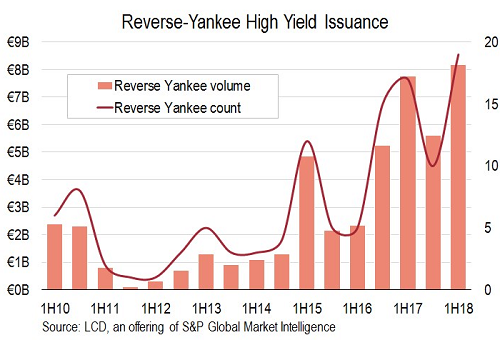
These bonds are hot for European investors who are wheezing under the iron fist of NIRP that dishes out guaranteed losses even before inflation on less risky bonds. Anything looks better than bonds with negative yields.
And here is why it makes sense for US companies to chase this money: It’s still ultra-cheap particularly for lower-rated companies. The chart below shows just how much sense it makes for the companies – though investors are going to have their day of reckoning.
The euro high-yield ICE Band of America Merrill Lynch index currently shows an average effective yield of 3.4% (red line). These are junk-rated companies!
The equivalent index for the US shows an effective average yield of 6.4% (black line). This is a spread between the two of 3 percentage points – thanks to a different central-bank regime.
Also note how during the euro debt crisis in 2011 and 2012, junk-bond yields spiked in both markets, but a lot more in the Eurozone to where the average euro-denominated bonds yielded well into the double digits:
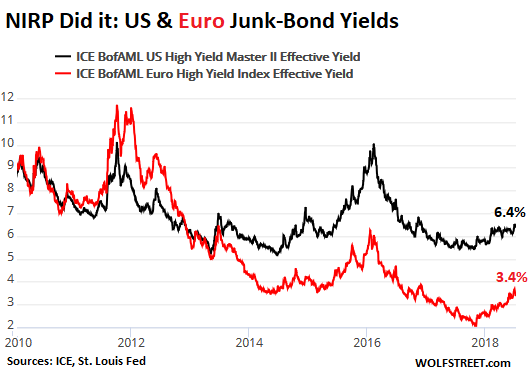
As the chart shows, the average euro junk-bond yield, while still ludicrously low at 3.4%, has surged from even more ludicrously low levels last year, when it fell below the 10-year US Treasury yield, a hilarious distortion that I pooh-poohed a few times not without some relish. In October 2017, the average euro junk-bond yield fell as low as 2.08%.
At the time, investors took sizeable credit risks on those bonds and are getting paid less than the rate of inflation to take those risks. Those investors are now getting punished. When yields rise, bond prices fall by definition. Investors can either sell those bonds at a loss or hold them to maturity at a yield of just over 2%, if a default doesn’t x out that option.
In terms of reverse Yankees, they’re ultra-cheap money for US companies. For investors, they’re engaging in similar credit risks with those euro-bonds as they do with dollar-bonds issued by the same US companies, but they’re getting paid only about half as much to take those risks!
I’m just in awe of how central-bank policies have blinded investors to risks and have altered rational thinking.
And yet, the US high-yield market – both for bonds and leveraged loans – is still richly valued as well, and yields are still very low. Credit is flowing easily and in large quantities despite the Fed’s ongoing efforts to tighten financial conditions – or “remove accommodation,” as it likes to say. And this ebullient junk-bond market in the US will see higher yields and lower prices. So the chart above is comparing one ebullient market (black line) with a vastly more ebullient market (red line) – though both markets have already taken a licking and are facing bigger lickings.
Rising interest rates have a peculiar effect. Read… Leveraged-Loan Risks Are Piling Up
Would you like to be notified via email when WOLF STREET publishes a new article? Sign up here.
Far from being a controversial figure like conservative judge Robert Bork, whose…
Source: Progressive Academia’s Threat to Free Speech – Taki’s Magazine


You must be logged in to post a comment.