Celeb Endorsements

THE FOUNDATION“We have seen the mere distinction of color made in the most enlightened period of time, a ground of the most oppressive dominion ever exercised by man over man.” —James Madison (1787)
IN TODAY’S EDITION
IN BRIEFUh Oh, Kanye Escaped the Demo Plantation AgainNate Jackson
Kanye West once again finds himself a “fugitive slave” of sorts for making his way via the Underground Railroad to an Oval Office meeting with President Donald Trump. There is nothing in this country that permits overt racism quite like a black person thinking for himself and refusing to toe the Democrat Plantation Party line. West, of course, is no stranger to this type of controversy. We last wrote about his politically incorrect comments back in April. But neither is Kanye a conservative hero thoughtfully pushing Republican policies. (Remember, he’s the same guy who declared after Hurricane Katrina, “George Bush doesn’t care about black people.”) Let’s face it: This was a celebrity president glad-handing with another celebrity. As for West, his sole “crime” is being pals with Trump, whom Democrats are politically invested in tarnishing as a racist. “Trump is on his hero’s journey right now,” West said during his White House visit. “He might not have thought he’d have a crazy motherf—ker like Kanye running up support.” Of his “Make America Great Again” hat, Kanye said, “There was something about when I put this hat on it made me feel like Superman. … You made a Superman cape for me.” Later, he got up, gave Trump a hug, and said, “I love this guy right here.” Lowbrow entertainment to be sure, but Leftmedia talkingheads were outraged. “Kanye West is what happens when Negroes don’t read,” CNN’s Bakari Sellers declared. Colleague Tara Setmayer joined in, declaring West to be “the token Negro of the Trump administration.” And CNN host Don Lemon summed it up, “What I saw was a minstrel show. … Him in front of all these white people, mostly white people, embarrassing himself and embarrassing Americans, but mostly African-Americans, because every one of them is sitting either at home or with their phones, watching this, cringing.” All three of those CNN analysts are black, which is the only other reason they were permitted to use such racist language. So why are leftists actually attacking Kanye? The big picture is that it’s about enforcing ideological conformity among Democrats’ favorite victimized identity group. But practically, it’s about votes. The Hill reports, “The president won 8 percent of the black vote in the 2016 election, according to exit polling, and Gallup’s tracking poll has long shown Trump’s support among African-Americans hovering between 10 and 15 percent.” If Kanye were to end up pulling off a few percentage points of the black vote from the Democrat column, November’s blue wave wouldn’t even make the beach. Democrats have built their coalition around 90% or more of the black vote, and they seek to do the same thing with other minorities, women, homosexuals, etc. Cracks in that alliance spell real electoral trouble, hence the vitriolic response to Kanye. Black Lives Votes Matter.
|
A man in his 60’s, who visits a certain Starbucks every morning for coffee, is credited with saving the life of an employee who found herself being attacked and beaten&hellip
— Read on concealednation.org/2018/10/armed-starbucks-customer-stops-man-from-brutally-beating-employee/
With the spectacular failure of clinical psychologist Dr. Prof. Christine Blasey Ford’s vague charges against Brett Kavanaugh to elicit any corroborating evidence, moral psychologist Jonathan Haidt’s new book about the apparent epidemic of politics-related mental illness that began around 2013,…
Source: 2013: A Race Odyssey – Taki’s Magazine – Taki’s Magazine
Just over a year has passed since over two million people in Catalonia voted in a banned referendum to leave Spain. On that day, the separatists were given a brutal lesson in the raw power of state violence. Days later, they were given another harsh lesson, this time in the fickleness of money. Within days of holding the vote, which was brutally suppressed but not prevented by Spanish police, Spain’s north eastern region was forced to watch as one after another of its brand names moved their headquarters, at least on paper, to other parts of Spain.
Among the first companies to up sticks were Catalonia’s two largest banks, Caixabank and Banco Sabadell, which feared being cut off from European Central Bank funding in the event, albeit unlikely, of Catalonian secession. That would have meant no more virtually interest-free loans from the ECB or access to Europe’s repo markets. In other words, a death sentence, as Caixabank’s then president Isidro Faine recently admitted.
The banks were also suffering a gathering run on deposits as customers shifted their money to other Spanish banks, either because they were afraid of what could happen to their funds in the event of independence or as punishment for the banks’ Catalan roots. In little more than a week, the two banks lost tens of billions of euros in deposits.
But what is only now becoming clear is just how central a role the Spanish government in Madrid was playing in fomenting this massive exodus of funds…
I was asked two important questions in this mind-boggling era of QE: The Bank of Japan has monetized 50% of its national debt; so why has there not been a surge of inflation? And why can’t the Fed restart QE and do the same without triggering inflation?
“Inflation” can be a lot of things. Here we’re not talking about “monetary inflation.” We’re talking about price inflation – when the currency loses its purchasing power. There are several types of price inflation that are accounted for separately, including:
The questions were about consumer price inflation; but the answer lies in asset price inflation.
It’s true that despite QE globally – not just in Japan – there has been relatively little consumer price inflation in the countries whose central banks perpetrated it. But it has caused enormous asset-price inflation. We call it the “Everything Bubble” where practically all asset classes globally have become ludicrously inflated.
Asset price inflation means that the currency loses purchasing power with regards to assets, such as real estate. The house is the same, only a little more run-down, but now it takes twice as many dollars to buy than five years ago.
When asset-price inflation reverses, which it invariably does, it can be deadly for the banks and the financial system overall. There are plenty of examples, including the US housing and mortgage crisis that was part of the Financial Crisis.
Assets are used as collateral by banks and other lenders. When asset prices get inflated, they support larger loans. But inflated asset prices invariably deflate at some point, and suddenly, when the borrower defaults, the collateral is no longer enough to cover the loan. Asset price inflation feels good because it translates into free and easy wealth for asset holders, but when it deflates, it tends to bring down the banks – even or especially the biggest ones – and causes all kinds of other mayhem.
Asset price inflation means risks are building up in the financial system.
So central banks, while they try to stimulate some asset price inflation, are worried when it goes too far. The Fed has expressed this worry in various forms for two years. The ECB is now murmuring about it. And even the Bank of Japan is suddenly fretting about the “sustainability” of its QE program, and its impact on the financial markets.
This is why QE cannot be maintained without setting the stage for another, and much bigger and even more magnificent collapse of the financial system, the Big One if you will, and all the real-economy mayhem it would entail.
Consumer price inflation – defined here as loss of purchasing power of the currency with regards to consumer goods and services, as measured by a consumer price index – is in part a confidence game.
Consumer price inflation results from a mix of market forces, psychology, and other factors. What exactly causes consumer price inflation is still not fully understood, as evidenced by the surprise that economists experienced when QE failed to cause it.
One factor in consumer price inflation is confidence in the currency – often measured as “inflation expectations.” Like so many other factors in economics, it’s psychological!
When the people have confidence that the purchasing power of their currency remains stable, and when businesses therefore cannot raise prices because people and other businesses would refuse to pay these higher prices, then inflation is “well anchored,” as central bankers say. This is expressed in various “inflation expectation” indices. But confidence can vanish, and once gone, it’s devilishly hard to rebuilt.
Over the past two decades, the Japanese have learned that there is very little or no inflation in their system:
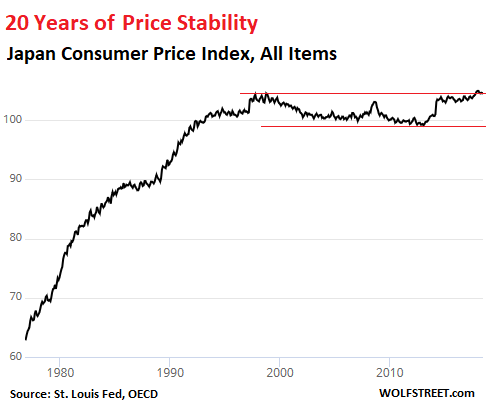
All economic players have adjusted to it — consumers, government entities, businesses, pension funds, etc. This confidence has made it effectively impossible to raise prices on many goods and services (with some exceptions). When companies tried to raise prices, consumers simply switched to alternatives or cut back, and the price increases didn’t stick.
The Japanese are hoarding cash (via yen deposits and other low-risk yen instruments) because they know it will retain its purchasing power. They trust the yen! This attitude – “inflation expectations” – has helped keep inflation to near zero. It’s a self-reinforcing mechanism.
On the other hand, there’s Argentina: Successive governments have for decades trashed any kind of confidence or trust people might have had in the peso. Argentines get rid of pesos as soon as they can (convert them into dollars or assets). In other words, they constantly sell pesos. The entire economy has adjusted to dealing with a currency that rapidly loses purchasing power. It too is a self-reinforcing mechanism.
During the 1970s, there was a lot of inflation in the US, reaching nearly 15% in 1980. It had to be stopped before it would spiral completely out of control. Fed Chairman Paul Volcker, with the gutsy public backing of President Reagan, went to work with rate increases of a full percentage point per meeting that shocked. This was accompanied by a publicity campaign.
It was radical surgery to rebuild confidence in the dollar, and it caused a nasty “double-dip” recession that threw millions of people out of work. But inflation began dropping. And over many years, it gradually rebuilt confidence that prices might rise by about 2% to 3% a year, not more. In the Fed’s terms, “inflation expectations are well anchored.” As long as that confidence persists, inflation will have a hard time spiraling out of control.
But in the US, this confidence is still fragile. Inflation expectations already ticked up to 3%. Once inflation expectations rise, all bets are off.
This can also crop up in Japan, and when it does, nothing and no one will be prepared for it – after two decades of price stability. If consumer price inflation gets out of hand, the loss of purchasing power of the yen will destroy much of the wealth of the Japanese and the purchasing power of their labor.
That is a risk. And it comes on top of the more immediate risk associated with asset price inflation – what it does to the financial system when the prices of leveraged assets deflate. That’s the mechanism by which QE becomes destructive. That’s why the price of free money can be very costly.
Despite repeated speeches to the contrary, the Bank of Japan is sharply tapering its QE. Read… QE Party Is Drying Up, Even at the Bank of Japan
Would you like to be notified via email when WOLF STREET publishes a new article? Sign up here.

A huge new study by a left-wing organization has slayed a sacred cow of the left by proving that the vast majority of non-white Americans reject political correctness.
The study was undertaken by scholars Stephen Hawkins, Daniel Yudkin, Miriam Juan-Torres, and Tim Dixon on behalf of leftist group More in Common.
As the Atlantic explains, “It is based on a nationally representative poll with 8,000 respondents, 30 one-hour interviews, and six focus groups conducted from December 2017 to September 2018.”
The survey found that a full 80% of Americans across the nation believe “political correctness is a problem in our country,” including 74 percent of young people aged 24 to 29, and 79 percent under age 24.
However, it’s when the responses are broken down by race when the results become even more intriguing.
“Whites are ever so slightly less likely than average to believe that political correctness is a problem in the country: 79 percent of them share this sentiment. Instead, it is Asians (82 percent), Hispanics (87 percent), and American Indians (88 percent) who are most likely to oppose political correctness,” writes Yascha Mounk.
Three quarters of African Americans also oppose political correctness.
In other words, some of the very people who white leftists claim to be representing when they push politically correct narratives reject political correctness even more vehemently than white people.
Among “traditional liberals,” 61 percent see political correctness as a problem, while almost a third (30 percent) of self-proclaimed “progressives” see it as a problem.
When asked to define exactly what it was about “political correctness” that concerned them, a significant number of respondents said they were worried “about their day-to-day ability to express themselves.”
At the end of his article, Yascha Mounk, a leftist lecturer on government at Harvard University, admits that the results indicative progressives are completely out of touch with the mood of the American people.
“The fact that we are so widely off the mark in our perception of how most people feel about political correctness should probably also make us rethink some of our other basic assumptions about the country,” he writes.
“The gap between the progressive perception and the reality of public views on this issue could do damage to the institutions that the woke elite collectively run. A publication whose editors think they represent the views of a majority of Americans when they actually speak to a small minority of the country may eventually see its influence wane and its readership decline. And a political candidate who believes she is speaking for half of the population when she is actually voicing the opinions of one-fifth is likely to lose the next election,” concludes Mounk.
SUBSCRIBE on YouTube:
Follow on Twitter:
Facebook: https://www.facebook.com/paul.j.watson.71
*********************
Paul Joseph Watson is the editor at large of Infowars.com and Prison Planet.com.


You must be logged in to post a comment.