……..as I was saying in my earlier post. Our Freedoms Are Under Attack

THE REAL FASCISTS: House Democrats Want Oversight Over FOX News

Democrats have discovered a form of media bias they don’t like. Naturally, it’s at FOX News. It seems they don’t like the fact that FOX News doesn’t march in lock step with the liberal media and that’s a big problem.

Breitbart reports:

House Democrats Want ‘Oversight’ over Fox News’ Editorial Decisions

Trending: Liberal FOX News Personality Juan Williams Worries Trump Will Refuse To Leave Office If He Loses In 2020

Democrats in the U.S. House of Representatives are demanding to know why Fox News did not publish a story prior to the 2016 election about an alleged affair years before between porn star Stormy Daniels and Donald Trump.

House Committee on Oversight and Reform chair Rep. Elijah Cummings (D-MD) wrote to former Fox News reporter Diana Falzone last month demanding that she turn over any documents relating to Trump’s alleged extramarital affairs.

An article in the New Yorker last month alleged that Fox News executive Ken LaCorte spiked the story to protect Trump — a claim LaCorte has vehemently denied, saying the story lacked corroborating evidence and that the network was merely practicing responsible journalism, as were other outlets who declined the story.

That article seems to have motivated Cummings’s letter — a letter that not only seeks personal dirt on the president, but seeks information that might be used to review Fox News’ editorial decisions. The committee’s letter suggests that Fox News may have violated campaign finance rules if it tried to help Trump by suppressing the Daniels story.

Of course, this could have more to do with the fact that more people watch FOX than the liberal networks. In fact, the ratings at FOX are still through the roof.

The Hill reports:

Fox News wins cable news ratings race for 69th consecutive quarter

Fox News won the cable news ratings race for the 69th consecutive quarter over MSNBC and CNN, according to Nielsen Media Research numbers released Tuesday.

Overall for prime time, Fox News averaged 2.45 million total viewers, topping MSNBC’s 1.91 million. CNN was third with an average of 1.06 million viewers.

In the key 25-54 demographic that advertisers covet most, Fox News averaged 421,000 viewers. MSNBC was second with 333,000 and CNN third with 308,000.

The top five individual shows on cable news for the quarter in total viewers were led by Fox News’s Sean Hannity, which averaged 3.165 million viewers per night. Fox News’s Tucker Carlson was second, with 3.087 million viewers, and MSNBC’s Rachel Maddow was third, with 3.067 million viewers.

Don’t Democrats in Congress have bigger problems to solve than obsessing over FOX News?

State Passes Bill To Seize Guns Based on Entirely “Unchallenged” Accusations, With NO Due Process


First off, like  asset forfeiture laws, I do not think this is constitutional and the courts will strike these laws down. They get away with it regarding asset forfeiture laws because dealing drugs is a criminal activity. Legally owning a firearm is not. What will happen here is similar to having someone SWATed. Someone calls in an anonymous complaint and the SWAT team shows up at your door.

The same thing can happen here regarding a constitutional right of gun ownership. An anonymous call comes into the police and without due process they come and take your guns? You have to prove your innocence to get them back?

This will be abused by people with personal grudges, or varying political views to hurt others who may be totally innocent. This will go bad in so many ways, that it makes me fearful of America turning into a police state. They are already going after free speech and now the right to protect ourselves and our families . What’s next?

We know those who seek to take away our freedoms will never stop at taking only a few.  Millions of unvetted illegal immigrants crossing our borders, a government 22 Trillion dollars in debt, endless wars, and control freak politicians, what could possibly go wrong?

I can only suggest that you move to a state that protects your gun rights and stay out of the ones that don’t. Vote with your pocketbook.


The Best in uncensored news, information, and analysis

Source: State Passes Bill To Seize Guns Based on Entirely “Unchallenged” Accusations, With NO Due Process

The Victim Culture/ Unherd

Who takes advantage of disadvantage?

Misfortune has a certain cachet in woke circles – but is ignored where it counts


Do you remember when, if people were going to lie, it was about being more successful than they actually were? Jeffrey Archer, for example – despite a career as a hugely saleable author – was found to have added some fictional lustre to everything from his school exam results to the nature of his Oxford degree. Gordon Ramsay, the chef, reportedly exaggerated tales of playing in the first-team squad for Glasgow Rangers, when, in fact, it was a single match as a triallist.

Most frequently, people bumped up their academic qualifications to get them to a next stage denied them otherwise, or to jazz up a mediocre past. Their belief was that the perception of past success would help to create its future equivalent. They were often right – unless they were unmasked.

Today, though, there is a new form of faking it to make it, with the same potentially explosive risks of discovery, and it speaks of a fundamental cultural change in our age: the steady rise – in specific settings – of social status associated with victimhood. In recent years, intensifying in the last few months, there have been a number of scandals in which people are alleged to have lied about grievous misfortune or perceived disadvantage.

Further reading

Victimhood culture will tear us apart

By Jenny McCartney

The most recent allegation – currently galvanising both Chicago and wider US politics – involved the US actor Jussie Smollett, a star of the drama Empire who is both black and gay, and who said he was attacked by two men wearing ‘Make America Great Again’ hats, who shouted racist and homophobic slurs and put a noose around his neck. Smollett was arrested by the Chicago Police Department on suspicion of staging the attack by arrangement with two men, allegedly in order to boost his profile and career.

Then all 16 charges against him were dropped, reportedly because Smollett had completed community service and forfeited a $10,000 bond payment, something which the Cook County State’s Attorney Kimberley Foxx described as “a just resolution and appropriate resolution to this case”. Yet there is, nonetheless, a nagging sense of public irresolution around the established facts.

The Illinois prosecutor, Joe Magats, has said that Smollett is “not the victim of a hate crime“, while Smollett continues to maintain that he was. The mayor of Chicago, Rahm Emanuel, is furious, saying that Smollett “actually committed a crime here, he lied about something”. And Trump himself – feeling his supporters to have been unfairly traduced by Smollett’s account – weighed in on Twitter, saying that the FBI and the Department of Justice are to review “the outrageous Jussie Smollett case”.

The Smollett case – inflamed by a feverish wider context – currently has all the makings of one of those national arguments in which the cold, dry facts of what actually happened seem fated to become subordinate to the question of which group one most strongly identifies with in the dispute.

Further reading

When did victimhood culture trump truth?

By Justin Webb

In the US, as the national atmosphere of racial tension has become more charged, hoax accusations of attacks have come from people of all races, often with a political spin. In October 2016, for example, Maria Daly, the white wife of a police officer, reported a theft at her home and that the house had been painted with ‘Black Lives Matter’ graffiti – police later found that she had staged the burglary and spray-painted the slogan herself. In December 2016, Yasmin Seweid, a student at Baruch College, claimed to have been attacked on the New York subway by three white men who tore off her hijab and shouted “Donald Trump!”. Seweid later admitted to making up the attack.

The desire falsely to claim misfortune has also manifested itself in other areas: Belle Gibson, a young, female Australian healthy-eating blogger, claimed to have been diagnosed with untreatable brain cancer, which she purported to be healing herself by following a “wellness diet”. This story was swallowed by press and publishers alike in its entirety, unscrutinised. Gibson’s cookbook, The Whole Pantry, was published by Penguin before her cancer story was exposed in 2015 as a hoax which had also led her to misappropriate charitable donations.

The author Dan Mallory, too, was at the centre of a scandal when an article in The New Yorker alleged that he had falsely claimed that he had cancer, that his mother had died, and that his brother had taken his own life. Mallory attributed these sizeable inaccuracies to the effects of his bipolar disorder, and his next book will come out as usual: the world of fiction is, in some ways, more forgiving of those who weave fictions around their own lives.

This wish to fabricate disadvantage is a sign that it has become a valued cultural commodity – in certain highly visible circles. Those who fake it clearly believe that something beneficial for them will flow from their deception: attention, for example, or the perception that they are a more deeply authentic and morally superior human being. Sometimes they seek to advance their political world view, or be applauded for their fortitude in overcoming setbacks. Sometimes, as with Belle Gibson, they crave commercial and popular success which is sharply boosted by a tragic yet inspiring back-story.

Further reading

Teen Vogue’s idiotic hypocrisy

By Douglas Murray

But just because a small minority of people fake such disadvantage, doesn’t mean that those phenomena aren’t very real. Every day countless people, unremarked by media, undergo gruelling ordeals, whether from domestic or street violence, mental health issues, racially-motivated attacks or discrimination, a doctor’s bleak diagnosis, sexual exploitation or harassment, homelessness or simply an increasingly desperate struggle to pay the bills at the end of the month.

The trouble is that such experiences are often only taken seriously when they are advertised in particular contexts, those which frequently demand some degree of luck or privilege to enter in the first place. Thus people who are mildly disadvantaged within relatively privileged settings – such as academic institutions or wealthy corporations – will receive massively more attention and sympathy than those who are enormously disadvantaged in underprivileged settings. A system of proportionate responses across the whole of society has fallen out of whack.

Within many UK universities, for example, the concept of ‘disadvantage’ now has its determined gate-keepers in the way that advantage once did: those individuals who decide who is and is not officially permitted admission. In this system, one generally achieves ‘disadvantage’ status through approved category membership rather than any individual claim to trauma.

When James Knight, a student at the University of the West of England, last year decided to stand as a ‘men’s officer’ in a bid to highlight the high male suicide rate and the inadequacy of mental health services, his initiative was met with outrage by some other students and National Union of Students officers. The NUS women’s officer, Sarah Lasoye, said that attempts to create a ‘men’s officer’ post stemmed from “a fundamental misunderstanding of liberation and almost always an unearned sense of entitlement“.

Further reading

Sex: a warning from history

By Matthew Sweet

Mr Knight eventually stood down, and yet his point was accurate: men account for roughly three-quarters of all suicides in the UK. While many other issues, including sexual assault and domestic abuse, disproportionately affect women, suicide is one that disproportionately affects men. Yet it was quickly dubbed “entitlement” for Knight even to raise it as a campaigning issue, as he was summarily refused any pass to the ‘disadvantage’ club.

The former US Vice-President, Joe Biden, currently finds his political career under threat because of accusations of ‘misconduct’ born – not of any sexual assault – but of alleged over-tactility towards women (and everyone else, it seems). A single ‘inappropriate’ remark in a high-flying corporate setting can now be enough to endanger a career, as the legal and reputational risk of a company not acting decisively enough towards a complaint has soared.

Yet just as corporate and political hyper-vigilance to perceived sexist offence is running high, society’s wider response towards women fleeing in terror from violent domestic abuse or death threats seems apathetic. Two women are killed each week in England and Wales by a current or former partner, yet numerous women’s refuges across the UK have closed due to council budget cuts (one in six since 2010) and – despite a recent government cash injection – many have yet to find a long-term model of funding.

Elsewhere in the UK, the most basic measures that assure an individual’s liberty and security in the world – affordable housing, a reliable wage and a functioning criminal justice system – are being rendered ever more precarious for the low-paid, often on zero-hours contracts. The cost of both UK home ownership and renting has risen rapidly, creating a housing crisis, with roughly 1.15 million UK households on waiting lists for social housing.

Further reading

How rival extremisms are firing up Britain

By Jenny McCartney

The fair operation of our criminal justice system is increasingly endangered, too, with frequent delays to cases, a shortage of duty solicitors, and barriers to accessing legal aid. The result is that worse-off individuals and families have steadily become more vulnerable to simple bad luck or malevolence.

There is a vast gulf in how the idea of disadvantage is now metabolised by the corporate, institutional or social-media world and by the underprivileged reality that ticks on grimly outside those structures. Within the former world – for those who have succeeded in reaching its threshold – evidence of past disadvantage can potentially be traded for moral and practical advantage (and it must be said that some of this advantage, such as access programmes for groups more usually excluded, does good and important things.)

Yet in the latter world, of run-down estates and unreliable employment, claims of disadvantage only publicise misfortune to an indifferent audience, or potentially make it worse. The steady decline of paid-for local campaigning newspapers, as was pointed out after the Grenfell disaster, has made it even harder for decisions of officials and corporations to be held accountable to ordinary people. And so the first question that swirls around the question of disadvantage is: who has the time and the voice to raise it?

Further reading

Why has the diversity debate left white working-class boys behind?

By Jenny McCartney

The rise in theoretical consciousness-raising does not always go hand-in-hand with pragmatic social change. In the US, for example, more than 700 academic institutions now offer ‘women’s studies’ with an emphasis on studying ‘power inequalities’. Yet the majority of US female workers – alone among those of developed nations – still have no right to paid maternity leave, a situation which most grievously affects the lowest paid women and their babies.

Those who need help the most are often unable to talk about their situation, or are unheard when they do, and therefore are widely ignored by policymaking that is increasingly steered by media pressure and publicity. A woman who is a victim of domestic violence, for example, is unlikely to make a noise about it, because she may be terrified of the present or future consequences.

I recently reported on the young, mostly male victims of ferocious paramilitary attacks in Northern Ireland, both Catholic and Protestant: they are generally unwilling to speak at all, because they are fearful that talking may invite further brutality and trauma.

Further reading

My social mobility shame

By Darren Loki McGarvey

There is a risk that ‘disadvantage’ becomes a form of performance – applauded only in those who have succeeded in transcending it – a packaged commodity, a competitive claim that generates intense clouds of words and theories, reflections and argument. Yet, meanwhile, the steady building blocks of a nation’s fairness, the big government policies designed to shore up equal chances in work and home life, are rotting away – and the conversation around that is considerably less passionate than it should be.

Is the ideological exploration of disadvantage – continuously picked over in modern academia and ‘intersectional’ theory – being nourished at the expense of practical action? The idea was, I think, that one would automatically lead to the other.

Yet at the moment, our society most resembles a person who talks constantly and heatedly about the effects of rain falling through a leaky roof, the question of who gets most soaked by the deluge, and the differing power relations of the people in the house – yet seems oddly reluctant to call round a roofer and pay the bill for fixing the damage.

It shouldn’t be complicated – even amid the intensifying psychodrama of Brexit – to agree that a building programme for social housing, a fully functioning justice system and targeted help for those at the clear extremes of need are where our campaigning energies should lie. And yet, it seems, it is.

New Green Fake Science

Joe Bastardi: Climate change agenda is being driven by hysteria, not facts

Throughout my 40 year career as a meteorologist, I have tried to live up to the responsibility I inherited from my predecessors. I was taught to strive for objective truth, irrespective of where the data would lead. Science is not a belief system based on feelings or subjective motives. It is about facts, evidence, theories and experimentation in search of a conclusion.

The impassioned speech by Rep. Alexandria Ocasio-Cortez, D-N.Y., to Congress last week revealed volumes about the intent and commitment of those pushing the Green New Deal. I can’t help but question if their positions are based on facts.

Ocasio-Cortez’s statements about adverse climate effects and policy proposals reflect a lack of knowledge about energy policy and the geopolitical and financial impacts of abandoning fossil fuels in a quick and reckless manner. “The world is going to end in 12 years if we don’t address climate change,” she said earlier this year – a statement clearly designed to elicit panic but hardly based on fact.

NICOLAS LORIS: THE GREEN NEW DEAL WOULD COST TRILLIONS AND MAKE NOT A DIME’S WORTH OF DIFFERENCE

In this age of political hysteria, we must all educate ourselves on the facts – the actual science. Unfortunately, there seems to be a total lack of awareness about important issues that scientists like myself – who aren’t paid by research grants – are concerned about.

Instead, climate science is being used as a political weapon, and the voices of scientists like me are being ignored or even vilified. I was under the impression that in the United States, all voices and arguments should be heard. Climate science is not settled science. If it was, why would there be a continuous flow of money to research it?

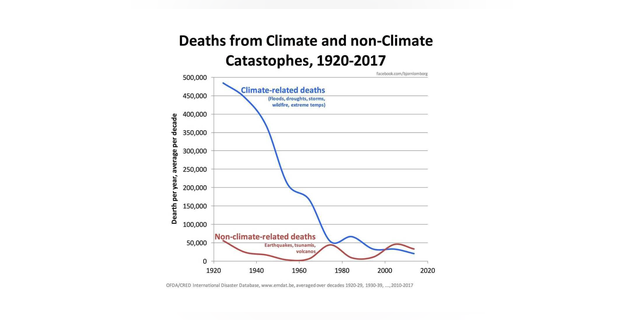
For example, is AOC aware that in the fossil fuel era, in spite of a four-fold increase in population, deaths have plummeted?

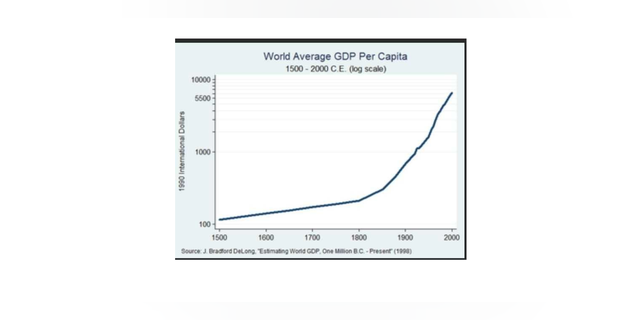
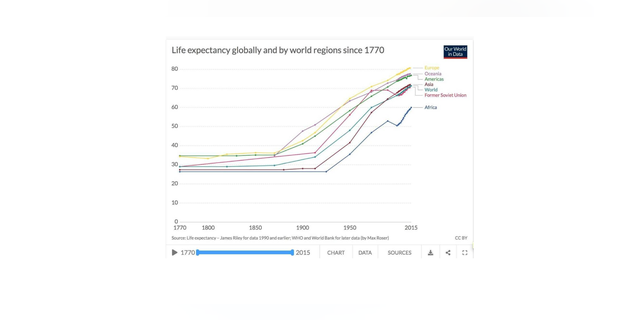
Or that personal GDP and life expectancy – true measurements of progress – have dramatically increased?

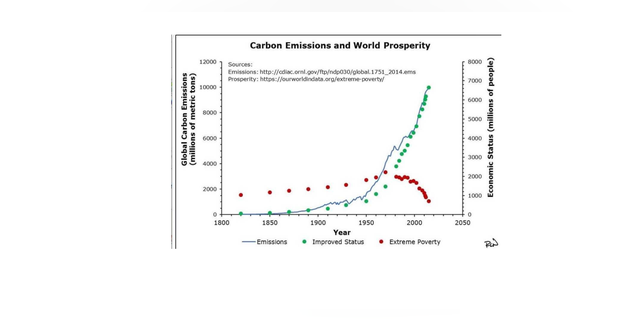
Or that world prosperity is rising while poverty is falling?

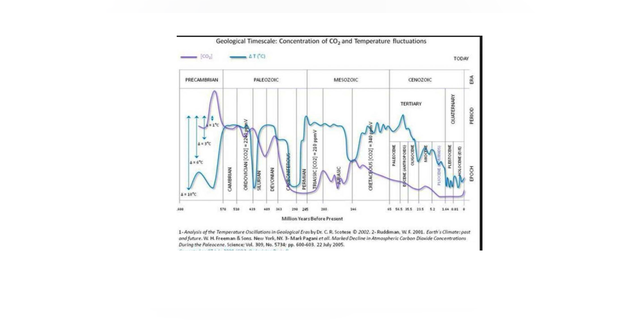
And does AOC know that in the geological history of the Earth, there is no apparent direct link between carbon dioxide and temperature?

AOC is trying to capture the imagination of young people to exact a specific result – the adoption of policies that cripple our way of life and push us towards socialism. But the charts above are only a few examples of data that should cause us to pause and ask questions about the direction that the Green New Deal wants America to go in.

We should also ask why there is such a hurry to get there. For every current event that is used to whip up hysteria, there has been a past event that was even worse, but that people either ignore or are ignorant about in the first place. Extreme weather has always occurred and will inevitably continue.

If climate alarmists do not know about the many arguments that question the credibility of their ideas, how is it even possible for their ideas to be seriously considered? Much of what is being proposed in the Green New Deal should not only cause skepticism, but should be considered draconian and even geopolitically dangerous.

The migration towards cleaner, alternative energy needs to be done in a methodical, sustainable and intelligent way, otherwise, the consequences could be far worse than anyone can imagine.

CLICK HERE TO GET THE FOX NEWS APP

Perhaps we should pause and consider why none of the global warming models from two decades ago have come to fruition. Perhaps we should slow down and think about the consequences of allowing our adversaries to supply the world with cheap energy, because one thing is for sure – wind farms and solar panels won’t get the job done.

The objective reader should examine all sides of the climate debate and should ask himself: Are the consequences of acting hastily worse than not acting at all? I think many are skeptical of rushing forward. We must rein in the political hysteria and fear-mongering that is driving the climate change agenda.

Joe Bastardi is a pioneer in extreme weather and long-range forecasting and the chief meteorologist at weatherbell.com. He is the author of “The Climate Chronicles: Inconvenient Revelations You Won’t Hear From Al Gore — and Others.”

Increase in Federal Gas Tax? (Mc Clatchy News)

These politicians have America in a 22 Trillion dollar debt hole and they want more of your money to spend. Now they can claim that the money from this tax will go to infrastructure to get people to buy into it.

We have heard this before. The money goes into the same black hole 🕳 that it disappears from, the federal government. Don’t let them fool you again. This is a regressive tax that will hurt the poor and people with long commutes the most. It will cause inflation as businesses pass along their gas tax increases to you by raising prices.

Is the cost of your gasoline about to rise? Washington looks ready to talk about a tax hike

The average price for a gallon of gas in the Bellingham metro area was $3.08 on Tuesday, which is 10 cents higher than a week ago.

The average price for a gallon of gas in the Bellingham metro area was $3.08 on Tuesday, which is 10 cents higher than a week ago. Staff The Bellingham Herald file

WASHINGTON

The Trump administration and congressional Democrats have found something they agree on — and it could mean higher taxes on gasoline and diesel fuel.

Last week, President Donald Trump’s transportation secretary, Elaine Chao, told senators that a gas tax hike was on the table when asked whether the White House would support such a move.

And this week, Democrats are indicating that they too are ready to consider a tax increase — an effort that would fund publicly popular infrastructure improvements but has hit a hard wall of opposition for years from fiscal conservatives and advocates for low-income people alike.

“I don’t think it should be off the table,” Rep. Pramila Jayapal, a Washington Democrat and co-chair of the Congressional Progressive Caucus, told McClatchy when asked about the prospect of the increase. The caucus has taken no formal position.

Several important, difficult steps remain before the current tax, 18.4 cents a gallon for gasoline and 24.4 cents a gallon for diesel fuel, would increase. But some sort of infrastructure package is under serious discussion in both the House and Senate by members of both parties, and Trump has said he’s open to ideas.

Why are gas prices rising so fast this spring?

Patrick DeHaan, head of petroleum analysis for GasBuddy, explains why the national average price of gasoline is now its priciest since July 2015. GasBuddy is a smartphone app that uses crowd-sourced information to track gas prices.

By GasBuddy

Freshmen House Democrats met privately Wednesday with House Speaker Nancy Pelosi of California to discuss plans. Rep. Earl Blumenauer, an Oregon Democrat who has been pushing for new infrastructure revenue sources for years, urged colleagues to spend the next few months building support back home for ways to fund spending.

“People ought to have their own community forums,” Blumenauer said.

Republicans and Democrats are motivated by the same forces: Constituent demands that infrastructure, notably roads and bridges, be improved now.

Some 47,052 of America’s 616,087 bridges were “structurally deficient” and in poor condition, according to a report this week from the American Road & Transportation Builders Association. It said the pace of repair slowed to its lowest point in five years.

Parts of Route 101, Interstate 405 and Interstate 5 in California had the most traveled structurally deficient bridges.

Iowa tops the list of states with the biggest number of structurally deficient bridges, followed by Pennsylvania, Oklahoma, Illinois, Missouri, North Carolina, California, New York, Louisiana and Mississippi.

There’s also political motivation to hike motor fuel taxes: It’s easier to increase a tax this year rather than in an election year.

Federal fuel taxes were last raised since 1993, and every time members of Congress try for an increase, they’re up against conservative refusals and liberal reluctance.

Those voices remain influential. “It is political stupidity at the highest and most suicidal level,” Grover Norquist, president of Americans for Tax Reform, said of a higher gas tax on Fox Business Network’s “Bulls & Bears” program recently. His group has been a leading opponent of any higher taxes.

He told McClatchy that the everything-is-on-the-table talk means, “You’ve told people absolutely nothing and giving them no reason to be mad at you.”

In the Republican-controlled Senate, GOP lawmakers are warming to the idea, but Senate Majority Leader Mitch McConnell of Kentucky has long been opposed to higher gasoline taxes and has not budged.

“We could consider it in the committee,” said Senate Finance Committee Chairman Chuck Grassley, an Iowa Republican, but he cited McConnell’s stance as a big roadblock.

Trump is the key to getting Republicans to go along. Asked if she supported a higher gas tax, Sen. Susan Collins, a Maine Republican, said, “I think we need to see an infrastructure package from this administration.”

Collins chairs the Senate appropriations subcommittee on transportation, where Chao made her comments about the tax.

Chao would give no timetable for adjusting taxes, but said “I think it’s an issue we all need to discuss.” She said those discussions would involve members of both parties.

“We have certainly learned from the past that such a project should not be done in isolation,” Chao said.

Among Democrats, liberals have also long been wary of gasoline tax increases, and talk about balancing any increase with other programs that help lower-income people. When the tax was last increased, Democrats also boosted income tax benefits for lower-income people.

Blumenauer, a member of the tax-writing House Ways and Means Committee, argued that lower-income people benefit from higher gasoline taxes, since they’re harder hit by the damage to their cars from poor roads and are more affected by traffic congestion since they often are paid by the hour.

Discussions about how to proceed will be complicated. The U.S. Chamber of Commerce has urged increasing the tax by a nickel over each of the next five years.

Rep. Peter DeFazio, chairman of the House Transportation and Infrastructure Committee, has talked about tying increases in the gas tax to inflation. Under his plan the tax could go up no more than 1.5 cents per gallon per year.

The smaller increase, DeFazio said, “is not going to be particularly disruptive of people’s personal budgets.”

A plan pushed by Rep. Sam Graves, a Missouri Republican and top GOP member of the transportation committee, offered another idea: Paying a tax based on how many miles one’s vehicle traveled. Last year, he described any effort to raise the gas tax to “beating our heads against the wall.” Wednesday, he said, “Everything’s on the table.”

Most federal government spending on roads and mass transit comes from the federal highway trust fund. Until 2008, the gas tax and other highway revenue sources funded the projects. But since then, the tax has been insufficient to cover costs so lawmakers have transferred money from the general budget to keep it afloat.

Shortfalls are expected to accelerate after 2021. A higher gasoline tax would bring in an estimated $1.8 billion per penny of increase per gallon, but such estimates are an inexact science. According to the Congressional Budget Office and Eno Center for Transportation, nonpartisan research groups, people would probably drive less – but that in turn would lessen the need for more highway repair.

David Lightman is McClatchy’s chief congressional correspondent. He’s been writing, editing and teaching for 47 years, with stops in Hagerstown, Riverside, Calif., Annapolis, Baltimore and since 1981, Washington.

Facebook and Child Brides

The Daily Beast gets credit

Child Brides in Africa Are Advertised on Facebook and Sold to Old Men

In one Nigerian community, illiterate fathers have learned from their sons that Facebook is a good way to let buyers know their daughters are for sale.

OBANLIKU, Nigeria—Monica, 16, is one of two sisters sold as wives to men who found their photographs on their father’s Facebook page and contacted him. She and her 14-year-old younger sister never wanted to get married until they completed their secondary education in Ogbakoko, a small village in Obanliku Local Government Area in Nigeria’s south-central Cross River state. But the teenage sisters fell victims to a culture which subjects little girls, some as young as 10, to de facto slavery through a tradition called “money marriage.”

The sisters belong to the Becheve community, a large tribe of 17 villages in Obanliku where there is a long tradition in which young girls—often referred to as “money women” or “money wives”—are sold in exchange for food or livestock or cash, or to settle debts.

Like hundreds, or perhaps thousands, of girls from the Becheve clan who are victims of money marriages, Monica and her sister were sold without their consent. Their father wanted to clear the debt he owed to a distant relative. The two sisters got married a month apart to men whom they did not know at all and who were old enough to be their grandfathers.

Their respective husbands got in touch with their father after seeing the Facebook page where he posted photos of his six daughters to draw the attention of his tribesmen. The men of the clan have found the new technology helps to extend and expand their old, exploitative traditions.

“My father knew nothing about Facebook until my elder brother bought him a smartphone and convinced him to join Facebook and post our photographs whenever he likes,” Monica told The Daily Beast. “He’ll buy new clothes and force me and my sisters to put them on before taking photographs of us.”

Usually in the Becheve community, parents of the money brides take the girls to men who can afford to pay for their daughters whenever they think they are fit for marriage, or wait for interested men to request their daughter’s hand in marriage. But in recent months, families who are so desperate to give their children away for money turn to Facebook so their kinsmen can check them out.

“It is young people who convince old men to look for wives on Facebook,” said Monica, who ran away from her husband to live with a friend less than a year after she got married. “The man I married said his oldest son showed him my photo on Facebook and directed him to my father.”

In effect, they use Facebook, quite literally, as a face book, although the actual exchange of money or goods does not take place online.

Spokespeople for Facebook, when contacted by The Daily Beast, were not familiar with the phenomenon as practiced in the Becheve community.

In other cultures where brides have been auctioned online, measures have been taken to stop the transactions.

Reports of Facebook being used as a tool to facilitate child marriage aren’t unique to Nigeria. Last November, the social media platform came under fireafter posts discussing the sale of a 16-year-old girl in South Sudan. The victim was married in the process after her father, in exchange for his daughter, received 530 cows, three Land Cruiser V8 cars and $10,000. The teenager reportedly was bid on by five men, including senior officials in the South Sudanese government.

Facebook said it took down the post as soon it learned of of it on Nov. 9, but that wasn’t until after the victim, Nyalong Ngong Deng Jalang, had been married off as the 10th wife of Kok Alat, a wealthy businessman from the country’s capital city of Juba, on Nov. 3. The post seeking bids for the teenager reportedly was published on Oct. 25.

After publication of the winning bid, Jalang achieved a certain notoriety in local media as “the most expensive woman in South Sudan.”

But the money wives of Becheve rarely receive any publicity, and often endure very difficult times as, in effect, chattel servants. They are usually not allowed to go to school and could be given out to another man if their husbands so desire. If the husband of a money wife dies, his next-of-kin becomes her new husband. The Becheve custom demands that if a money wife dies without bearing any child, her parents can bring another girl in the family to replace her. Regardless of the treatment she gets in her husband’s house, a money wife is not to run back to her parents.

“The practice is meant to boost the status of the men in Becheve community,” Magnus Ejikang, a local chief in Ogbakoko, told The Daily Beast. “The more brides you have, the more respect you gain in the community.”

But for many money wives in the Becheve community, the experience in their husband’s home is often disastrous, with reports of marital abuse and exploitation.

“Once he married me, he turned me into his slave and punching bag,” said Monica, who—just like her sister—was given away to her husband for 20,000 Nigerian naira (about $50), along with two goats, a pig and some yams. “He said he paid so much to marry me and so I had to labor hard by working for hours everyday in the farm to prove that I’m a grateful wife.”

Monica and her sister, who is still married to her 65-year-old husband, aren’t the only girls to have ended up in forced marriage after their photos appeared on Facebook. Regina, another teenager from the Becheve tribe, was sold in January by her parents to a man already married with two wives and 11 children. Her husband found her photo on the Facebook page of her uncle, who is notorious for putting photographs of his female relatives on the social media site to draw the attention of men from Becheve seeking child brides. She was then forced into marriage after her uncle pressured her parents, to the dismay of her older brother.

“Our greedy uncle, in his usual way of manipulating his brothers into selling their daughters, convinced my parents [to give out their daughter in marriage] because he wanted a share of the bride price money,” John Ashua, brother of 15-year-old Regina, told The Daily Beast. “He earns a living by looking for husbands for the girls in the family even when they are not ready to get married.”

Married life has been difficult for Regina herself. Besides having to drop out of school and carrying out most of the chores at home, she has to look after her husband’s livestock, which includes dozens of goats and pigs, and she is punished if she doesn’t work as demanded.

“He beat me last night because I said I was tired and couldn’t have sex with him,” Regina, who is now pregnant, complained to her brother on the telephone. “Whenever he returns home at night, he demands sex.”

Facebook is hugely popular in Nigeria with about a fifth of the country’s 98 million internet users connected to the site. But in rural areas like the Becheve community, where literacy levels are not so high among the elderly, the social media platform is mostly common among young people, who are the greatest owners of smart phones. Activists say youths in the clan are actually the brain behind men searching for money wives on Facebook.

“The majority of Becheve men knew nothing about Facebook until their sons and other young relatives began to show them photos of young Becheve girls on the platform,” Queen Eteng, a researcher with the Nigerian women’s rights NGO, Our Women Network, told The Daily Beast. “Most fathers don’t run the Facebook pages opened in their names. Rather it is younger family members who create the pages and post the photos.”

In the Becheve community, the practice of child marriage is deeply rooted in its customs and tradition. While rights campaigners admit it will be challenging changing the age-old tradition, they do nevertheless believe that the scale of the practice could easily be reduced.

“Young people have a huge role to play in putting a stop to this brutal tradition,” said Odey, whose organization works to end child marriage in Cross River state. “We are reaching out to young men in Becheve community to put a stop to the use of Facebook to display photos of girls for the purpose of having them married.”


The Trump Economy CNBC

US weekly jobless claims drop to the lowest level since 1969

The number of Americans filing applications for unemployment benefits dropped to a more than 49-year low last week.

The number of Americans filing applications for unemployment benefits dropped to a more than 49-year low last week, pointing to sustained labor market strength despite slowing economic growth.

Initial claims for state unemployment benefits declined 10,000 to a seasonally adjusted 202,000 for the week ended March 30, the lowest level since early December 1969, the Labor Department said on Thursday.

Data for the prior week was revised to show 1,000 more applications received than previously reported.

Economists polled by Reuters had forecast claims rising to 216,000 in the latest week. The Labor Department said only claims for California were estimated.

Claims have shown no sign of a pickup in layoffs even as the economy has lost momentum as the stimulus from a $1.5 trillion tax cut package fades. Companies are experiencing a shortage of workers, which contributed to a recent slowdown in hiring.

Job growth has slowed from last year’s roughly 225,000 monthly average pace. The pace of increase, however, remains more than sufficient to keep up with growth in the working age population, holding down the unemployment rate.

Initial jobless claimsWeek ending Saturday, seasonally adjusted200820102012201420162018100000200000300000400000500000600000700000Labor Dept

The four-week moving average of initial claims, considered a better measure of labor market trends as it irons out week-to-week volatility, fell 4,000 to 213,500 last week, the lowest level since early October 2018.

The claims data has no bearing on March’s employment report, which is scheduled for release on Friday. According to a Reuters survey of economists, nonfarm payrolls likely increased by 180,000 jobs last month after a meager 20,000 in February, which was seen as pay-back after robust gains in the prior two months.

The unemployment rate is forecast unchanged at 3.8 percent.

Thursday’s claims report showed the number of people receiving benefits after an initial week of aid decreased 38,000 to 1.72 million for the week ended March 23. The four-week moving average of the so-called continuing claims slipped 8,000 to 1.74 million.