Change Direction Now

December 22, 2025Today we’re continuing our look back at past articles that foresaw today’s headlines years in advance. Last week, we highlighted three early pieces tracing the decline of US credibility—its unsustainable debt path, the erosion of reserve currency privilege, and the rising global demand for real assets like gold.Today we look back at this podcast I recorded on March 31, 2023. I laid out a theory that Venezuela—sitting on the world’s largest oil reserves—might one day be absorbed into the US sphere of influence, not through war, but through corporate proxies.Drawing parallels to the East India Company and the US-backed creation of Panama, the idea was that a private entity could step in amid Venezuela’s chaos, secure its oil, and quietly serve American strategic interests.Now, with tensions escalating, the threat of an invasion could be the method of securing this kind of control. Maduro has discussed terms for stepping down, and recently US authorities seized a Venezuelan oil tanker.And Venezuela’s opposition leader, María Corina Machado, is now openly pitching the country’s energy sector as “a $1.7 trillion opportunity,” promising, “We will open all [oil], upstream, midstream, downstream, to all companies.”It felt like the right time to revisit this episode.
 
At the center of Sovereign Man’s core ethos is the indisputable view that the United States is in decline. I take absolutely zero pleasure in writing that statement. But it’s incredibly difficult, if not impossible, to objectively appraise the bountiful evidence at hand and not reach the same conclusion. Consider the following: US government finances are appallingly bad. The national debt exceeds 100% of GDP, annual deficits run into the trillions of dollars with no end in sight, and major trust funds for Social Security and Medicare will soon run out of money. Political incompetence is mind-blowing; politicians fail to be able to even identify problems, let alone understand them, let alone reach compromises to solve them. Ditto for central bank incompetence. These people simply cannot understand how, by keeping interest rates at zero for nearly a decade and conjuring trillions of dollars out of thin air, they engineered record high inflation. And they also fail to understand how their actions to ‘fix’ inflation are causing widespread havoc in the economy and financial system. Social divisions across the country are extreme. Censorship and cancel culture prevail, and corporations now wag their fingers at their own customers to “be better”. The education system is in pitiful shape, with many politicians and school board officials turning classrooms into activist training camps. The population is terribly unhealthy. Obesity and drug addiction are epidemics. Plus there’s an obvious mental health crisis that drives far too many people to commit horrific acts of violence on innocent people, including children. National security is in decline. Military readiness is down, yet top officials seem more concerned about diversity and inclusion rather than the ability to prevail in war. The rule of law has been perverted, including for political purposes and self-aggrandizement. We just saw another example of this yesterday. Even the national fertility rate continues plummeting– an indication of the rising cost of living and social apathy. The Wall Street Journal recently published a series of polls indicating that most Americans doubt their children will have a better future; pessimism is strong. They also found that certain values which once defined American culture, including a sense of community, hard work, and civility, are no longer important to the majority of people. This is all happening at a time when adversaries are circling. And that includes China. Now, usually whenever I bring up China, there are always people who are quick to assert that China cannot possibly replace the US as the dominant superpower because they have just as many problems. And it’s true that China has a ton of problems. They have their own debt issues, financial system chaos, and economic problems. They have social challenges, a major demographic crisis, and even a serious issue with childhood obesity. But no civilization or empire throughout history has ever been problem-free.Ancient Rome, even during its early republic days, had enormous problems. They had to deal with constant revolts, civil war, the genocidal dictatorship of Sulla, famine, war, plague, and more. Yet there’s an enormous difference between taking on challenges while you’re on the rise… versus succumbing to them while on the way down. Rome was able to deal with its challenges and continue its rise to become the dominant superpower. China may be able to do the same. The US finds itself in a precarious position where they have a mountain of compounding problems… and no ability to even slow them down, let alone solve them. I’ve written before about what I call the “Four Forces of Decline”, which I define as: 1) Forces of History– the inevitable, cyclical nature in the rise and fall of Empire. No empire, no civilization in human history has ever retained the top spot forever, and most tend to experience similar challenges on the way down. 2) Forces of Society– the vicious way in which a society eats itself from within, vanquishing the ability and inclination to solve complex problems. 3) Forces of Economy– the debilitating toll that enormous debts, deficits, and currency inflation take on a nation and its people. 4) Forces of Energy– when energy is cheap and abundant, prosperity reigns. When energy is expensive, prosperity wanes. The relationship couldn’t be more clear. Today’s podcast puts all of these together, with a particular focus on #4, Forces of Energy. Part of being the dominant superpower in our modern world means having access to abundant energy. Yet the US government has spent the last few years trying to destroy its energy (oil and gas) industry. They’ve been pretty successful. The President of the United States hardly misses an opportunity to bash oil companies. Politicians pass new rules and taxes to punish them. The media beats up on them. Investors have pulled funding for them. So it shouldn’t be a surprise that US oil production, while not in terminal decline, is failing to keep up with growing demand. Shale oil is especially problematic given that most of the highest quality “tier 1” sites have already been drilled. Many are already in decline. This is a big deal. Shale oil is the reason why the US achieved near energy independence. With shale in decline, the US will be forced to import a LOT more energy (which, again, is critical for prosperity) from places where they have an increasingly adversarial relationship. Russian oil is obviously off the table. So is Iranian oil. Saudi Arabia is rapidly becoming cozy with China; in fact the Saudis are now publicly considering to sell their oil in Chinese currency, the renminbi. This is an enormous threat to the US. Saudi Arabia has been selling oil in dollars for decades; they’ve even had their currency, the riyal, pegged to the US dollar since 1986. This concept of selling oil in US dollars is known as the petrodollar, and it’s one of the key reasons why the US dollar is the global reserve currency. Anyone who wants to buy oil needs to own US dollars. And that pretty much includes every country on the planet. So foreigners are forced to stockpile dollars, and by extension, US government bonds… simply because they need dollars to buy oil. As a result the US government is able to get away with the fiscal equivalent of murder. They can run multi-trillion dollar deficits every year. They can wage expensive wars in foreign lands. They can go into debt to pay people to stay home and NOT work… … and they’ve always had a bunch of suckers overseas– foreigners who have no choice but to buy US government bonds, simply because oil is priced in US dollars. But what if Saudi Arabia started selling oil in renminbi? Most likely a LOT of foreigners would dump at least some of their dollars and start holding renminbi as part of their official reserves. America’s biggest privilege and benefit– its reserve currency– would vanish, practically overnight. Suddenly the US government wouldn’t be able to run multi-trillion dollar deficits. It wouldn’t be able to go into debt to pay people to stay home and NOT work. They’d have to be like almost every other country– act with some fiscal responsibility. Think about it– if the President of Mexico shook hands with thin air, investors would be rightfully terrified and panic-sell Mexican government bonds. If South Korea ran a multi-trillion dollar deficit, its currency would probably plummet. Back in September we saw the British pound and UK government bonds practically collapse… and the Prime Minister of one of the world’s largest democratically elected sovereign governments was forced to resign… simply because investors didn’t like her economic revival plan. These issues are all linked. If the US continues to demonstrate incompetence and weakness… if they continue to subvert and destroy the energy industry… and if Saudi Arabia starts selling oil in renminbi… … the consequences will be life-changing. This is one of the biggest stories of our lives. It’s easy to miss because it’s playing out over a period of years. It gets lost in the day-to-day noise and the crisis du jour. But rest assured this is happening in front of our very eyes; it’s a slow motion crash that’s already started. The outcome isn’t inevitable yet. But nothing about these people’s actions demonstrate that they have the slightest clue what’s going on. Join me in today’s podcast as we dive further into this… and I outline my “51ststate” theory– a ‘solution’ that I wouldn’t be surprised to see in the near future. To your freedom, James Hickman
Co-Founder, Schiff Sovereign LLC

Trump’s Spending Bill.

Hat Tip to Epoch Times.

President Donald Trump’s public blowup with billionaire Elon Musk stems from a dispute over the fiscal impact of Trump’s mammoth tax-and-spending package, dubbed the “big, beautiful bill.” 
Musk and other critics have said the House-passed bill would worsen the federal government’s fiscal health. 
The White House has rebutted these claims, noting that the reconciliation package is not a budget bill or a blueprint for balancing the budget. 
Instead, it is a procedural tool designed to advance as much of the president’s agenda through Congress as possible, based on the Republican votes currently available, and it excludes projected revenue from tariffs and economic growth tied to tax cuts, according to Trump’s top budget official Russ Vought. 
Still, various organizations estimate that this legislation will exacerbate federal deficits and contribute to the national debt over the next decade. 
Here is a look at the different projections through the 2025–2034 budget window. 
Clashing Estimates: CBO versus White House
The Congressional Budget Office (CBO), a nonpartisan budget watchdog, released its scoring on the House-approved package. 
In its June 3 report, the CBO projected that outlays would decline by more than $1.25 trillion, but revenues would fall nearly $3.7 trillion. This will result in a $2.4 trillion increase in federal deficits over the next decade. 
White House Deputy Chief of Staff Stephen Miller, in a lengthy post on the social media platform X, disputed the CBO’s projection that the bill increases the deficit. 
“This lie is based on a CBO accounting gimmick,” he said. 
“Income tax rates from the 2017 tax cut are set to expire in September. They were always planned to be permanent. CBO says maintaining ‘current’ rates adds to the deficit, but by definition, leaving these income tax rates unchanged cannot add one penny to the deficit.” 
Vought also rebuked the CBO’s scoring methodology. 
“CBO continues to use a baseline that is fundamentally skewed toward the way the real world is,” Vought said in a press call. 
“The basics of that is that they assume that all spending will continue into eternity, your appropriations bills, all of your mandatory spending that gets a free ride into eternity, but somehow tax relief that has an expiration date isn’t assumed for the entirety of the fiscal window.” 
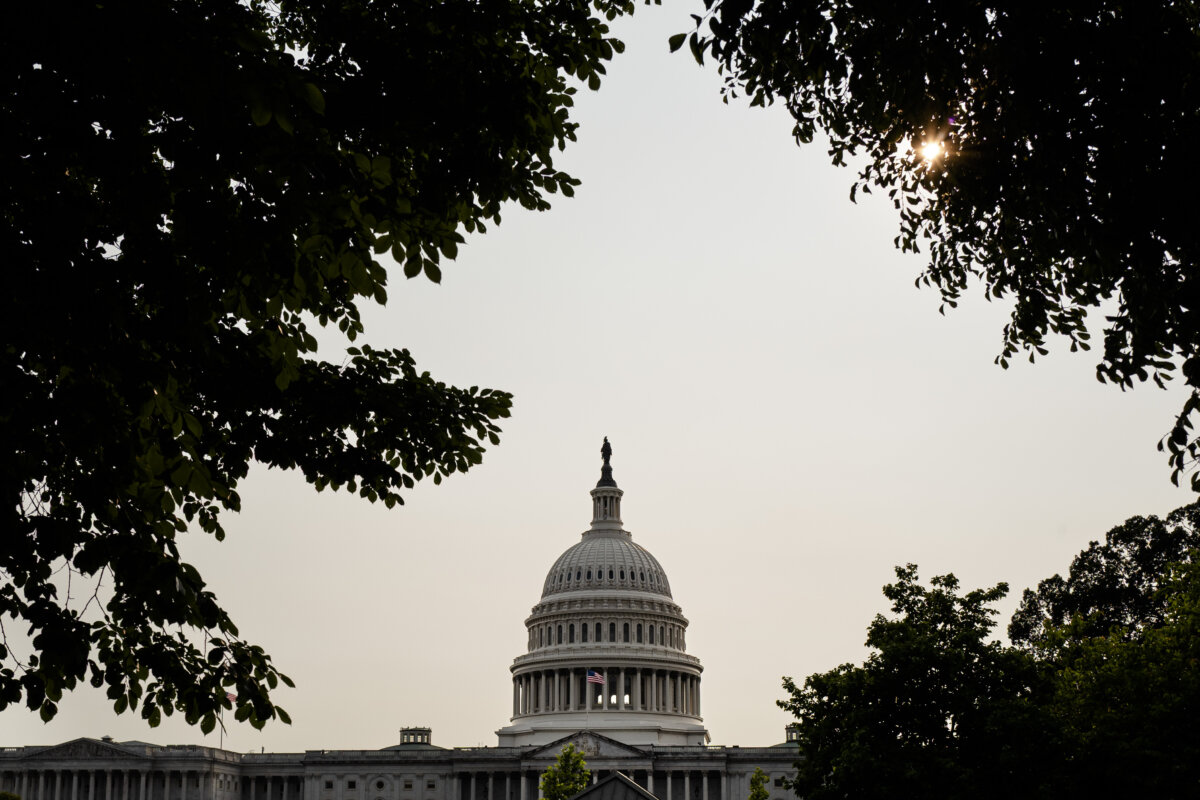
Epoch Times PhotoThe U.S. Capitol building in Washington on June 3, 2025. (Madalina Vasiliu/The Epoch Times)
Speaking to reporters at the White House during the president’s meeting with German Chancellor Friedrich Merz, Treasury Secretary Scott Bessent also alluded to the CBO’s recent tariff projections. 
This week, the CBO projected that tariff revenues will slash deficits by $2.8 trillion over 10 years, which Bessent said “puts the bill in surplus if you include the tariff revenue, which they won’t do.” 
What Do Other Forecasters Say?
Meanwhile, other independent organizations have presented similar debt and deficit projections for the bill. 
The Tax Foundation estimated on May 23 that the bill would result in a $2.6 trillion increase in the deficit. 
“Overall, the bill would prevent tax increases on 62 percent of taxpayers that would occur if the TCJA expired as scheduled,” Tax Foundation economists said. 
Last month, the University of Pennsylvania’s Penn Wharton Budget Model forecast that the reconciliation bill would raise deficits by $2.8 trillion. 
According to Yale’s Budget Lab, over a 30-year window, the bill would add $10.8 trillion to the national debt. 
“If the tax provisions become permanent, with no additional tariff revenue, the debt-to-GDP ratio would hit approximately 191 percent in 2055. The only countries that currently have a higher debt-to-GDP ratio are Japan and Sudan,” the Budget Lab said in its May 30 update
Bill Would Boost Economic Activity: White House 
Once the bill is enacted, the White House states that the administration’s actions, whether increased tariff revenues or substantial spending cuts, will reduce deficits by “at least $6.6 trillion over the next decade.” 
Supporters argue that the tax-and-spending plan, which includes tax cuts, would increase government revenues through more vigorous economic activity. This concept is related to the famous Laffer Curve, developed by the eminent economist Art Laffer. 
According to the Laffer Curve, popularized in the 1970s, there is an optimal tax rate that maximizes revenue, highlighting the relationship between tax rates and tax receipts. 
Following the passage of the 2017 Tax Cuts and Jobs Act, actual revenue from 2018 to 2024 totaled approximately $28.5 trillion. This has been $1.5 trillion higher than CBO’s projections—before adjusting for inflation. 
Interest Cost on New Debt
In a separate CBO report, released on June 5, officials predict that the One Big Beautiful Bill Act would trigger additional debt-servicing costs of $551 billion over the 10-year period. 
“That change would increase the cumulative effect on the deficit to $3 trillion,” the report stated. 
Experts from the Committee for a Responsible Federal Budget, an independent policy organization, estimate that interest costs on the new debt from the bill will amount to $1.8 trillion, accounting for 4.2 percent of GDP. 
If interest rates remain elevated—the benchmark 10-year Treasury yield hovers around 4.5 percent—interest payments could surge to $2.1 trillion in 2034, representing more than 5 percent of GDP. 
“All else being equal, higher debt and deficit levels will raise interest rates,” the Yale Budget Lab said. 
Fiscal health concerns have taken center stage in the U.S. Treasury market. 
While rates have stabilized, the 30-year Treasury yield recently topped 5.1 percent, the highest level since October 2023. 
This is a vital development since it influences consumer and business borrowing costs and how much it costs the federal government to service the debt. 
“Investors may demand higher compensation (more yield, lower bond prices) given the anticipated deficit spending trajectory and elevated bond issuance in coming years,” said U.S. Bank strategists in a May 22 note
Over the past few years, federal interest payments have increased significantly amid tighter Federal Reserve monetary policy and rising government spending. They are now the second-largest budgetary item, second only to Social Security. 
Annual federal interest payments are expected to exceed $1.2 trillion this fiscal year, according to the Treasury Department
Rocket Fuel or Lackluster Growth?
Many estimates suggest that the bill would provide a boost to the U.S. economy. 
Penn Wharton projects that its economic effects would increase GDP by 0.4 percent in 10 years and 0.7 percent in 30 years. The Tax Foundation expects long-run GDP to grow by 0.8 percent. 
The tax-writing House Ways and Means Committee is more bullish, predicting real economic growth of up to 5.2 percent over the next four years. 
On the labor front, according to the Tax Foundation, “hours worked converted to full-time equivalent jobs” would be 983,000. Additionally, pre-tax wages would grow by less than 0.05 percent. 
Average wages are projected to decline by 0.2 percent over the next 10 years but increase by 0.3 percent thereafter. 
The committee says up to 7.4 million full-time jobs will be saved or created, and workers could receive up to $11,600 in higher wages. 
Emel Akan contributed to this report. 
Frank FangFrank Fang 
To dig deeper into the subject, read the 

If you let people keep more of their own money, it will stimulate the economy and create growth in the private sector. If we do not reinstate the tax rates we have now, more money will go to the government, for them to waste. Tax and spend did not work before and it will not work now. A balanced budget might give us a chance to grow out of the 35 trillion dollar debt, eventually. We did not get here overnight and we won’t get out of this anytime soon, but that does not mean we should not try.

The Real New World Order

🧵 WHAT YOU’RE NOT HEARING: The Chinese cannot replace the U.S. market. Without it, the Chinese economy collapses.

Here’s why… China’s entire economic miracle was built on ONE thing – being America’s cheap manufacturing hub. 

The “Chinese miracle” playbook was simple: 

• Open markets to the West 

• Offer dirt-cheap labor 

• Ignore safety standards 

• Let Western companies rake in profits 

This worked for decades. But China forgot something crucial: others can do this too.

MASSIVE MISCALCULATION: Beijing thought the American leaders they made rich would protect them forever. They believed these corporate puppet masters would never let the US stand up to China.

WRONG. Along came Donald Trump, who owes them nothing.

The numbers don’t lie 

• US exports to China: $143.5B 

• Chinese imports to US: $438.9B 

They flood our markets while closing or restricting THEIR markets. 

But Trump said: NO MORE

Meanwhile, countries like India, Vietnam, and Bangladesh are CELEBRATING. They’re ready to take China’s place, AND open their markets to the U.S. – and Trump’s willing to deal.

HERE’S what the Enemedia WON’T tell you: 

Chinese exporters are PANICKING 

• Abandoning shipments mid-voyage 

• Factory orders FROZEN 

• Container volume DOWN 90% 

And this is just the beginning. China can’t replace the U.S. market that made it rich.

Reports flooding in: 

• Factories shutting down 

• Amazon canceling orders 

• Stores closing 

• Warehouses overflowing 

The house of cards is falling. But the Enemedia gives you nothing but Chinese propaganda.

CRUCIAL FACT: America buys 3X more than Japan (China’s next biggest customer). 

Without us, they’re FINISHED. And they were already on the ropes.

Will this affect US consumers? Sure, briefly. You might struggle to find cheap plastic junk for a few months. 

But other countries will step up. And TRILLIONS in new investment are flowing into America, while countless factories LEAVE China.

Will this affect US consumers? Sure, briefly. You might struggle to find cheap plastic junk for a few months. 

The bottom line: China picked a fight they can’t win. While America adjusts, the CCP will face the consequences of their refusal to truly open their own markets, or to abandon aggression against their neighbors. 

Game over. The decoupling is under way.

Rod Martin, 

Founder and CEO Martin Capital

Epoch Times on Tariffs

WASHINGTON—As part of a bold shift in U.S. trade policy, President Donald Trump has ramped up tariffs on Chinese goods, aiming to revive domestic manufacturing and hold Beijing accountable for its decades of market-distorting practices. 
At the April 2 “Make America Wealthy Again” event in the White House Rose Garden, Trump unveiled the contours of his global tariff plans, including a 34 percent reciprocal levy on Beijing. The president pointed to China’s currency manipulation and other non-monetary trade barriers. 
This decision effectively raised the total new tariffs on China to 54 percent, including the 20 percent levies previously imposed to pressure Beijing into reducing the flow of fentanyl into the United States. 
This move will impact the approximately $600 billion in annual trade and bring tariffs on nearly all Chinese goods close to the 60 percent rate Trump had previously promised during his campaign. 
Trump believes that the United States holds leverage over other nations, including China, due to its status as the world’s largest and wealthiest consumer market. 
“Foreign nations will finally be asked to pay for the privilege of access to our market, the biggest market in the world,” Trump said during his Rose Garden speech. 
China quickly hit back, announcing that, starting April 10, it would impose 34 percent tariffs on imports of all U.S. goods. This move was part of a broader set of retaliatory actions, including tightening export controls on various rare earth elements and adding U.S. companies to the government’s “unreliable entities list.” 
Beijing also filed a complaint with the World Trade Organization (WTO), following through on a threat earlier this week. 
Trump pushed back at the Chinese regime after announcing its retaliatory response. 
“China played it wrong, they panicked—the one thing they cannot afford to do,” the president said in a post on social media platform Truth Social. 
Trade Distorting Practices
Despite joining the WTO in 2001, China did not evolve into the fully-fledged market economy that the United States had anticipated. 
China’s economic growth has accelerated dramatically since the country joined the WTO. However, the Chinese Communist Party’s trade-distorting practices, such as intellectual property theft, massive state subsidies, currency manipulation, wage suppression, and labor rights violations, have led to the closure of many U.S. manufacturers and the loss of millions of U.S. jobs. 
There is a bipartisan view in Washington on the need to address China’s market-distorting practices. 
Before the November election last year, President Joe Biden’s National Security Advisor, Jake Sullivan, defended tariffs against China. 
“Previous efforts to build a China policy on changing China have not succeeded,” Sullivan said on Oct. 24. 
As a result, he argued, the United States must adopt a new set of strategies based on the current geopolitical and economic realities. 
During his first term, Trump imposed tariffs on more than $300 billion worth of Chinese goods in response to various unfair trade practices, including intellectual property theft. 
The Biden administration chose to maintain those tariffs and even announced additional tariffs on products such as electric vehicles (EVs), solar panels, medical equipment, lithium-ion batteries, steel, and aluminum. 
Both administrations have used tariffs to level the playing field for domestic manufacturers and protect American workers. 
However, Trump’s latest move represents an even bolder step in attempting to contain China and hold it accountable for its longstanding trade-distorting practices. 
Nick Iacovella, executive vice president for the Coalition for a Prosperous America, an organization that represents domestic producers and workers, said that these tariffs will address the decades of deindustrialization in the United States. 
“It is incredibly important that those tariffs actually stay in place,” he told The Epoch Times. 
For decades, there has been a disconnect between Wall Street and Main Street, Iacovella added, commenting on the market reaction. 
“When automakers moved their jobs to Mexico, their stock prices went up, but car prices didn’t decrease for American consumers,” he said. 
Adam Savit, China policy director at America First Policy Institute, argues that China has less leverage, despite Beijing’s retaliatory actions. 
“The U.S. has much less exports to China than China exports to the United States. So inherently, they’re at a disadvantage,” he told The Epoch Times. 
​​He stated that charging 54 percent tariffs on Chinese goods is an appropriate response to an adversary, and it will help in the strategic decoupling from China. 
Bargaining Chip 
On April 4, Trump extended the deadline for TikTok to divest from its Beijing-based parent company by 75 days. 
The president made the announcement in a post on Truth Social, just ahead of the original April 5 deadline. 
Trump stated that he would continue working in “good faith” with China. Previously, he suggested that tariffs could be used as a bargaining chip to pressure China into approving the sale of TikTok’s U.S. operations from ByteDance, which several U.S. officials have warned has ties to the Chinese Communist Party. 
“You have a situation with TikTok where China will probably say: ‘We’ll approve a deal, but will you do something on the tariffs?’” Trump said on April 3. “We could use tariffs in order to get something in return.” 
Nathan Worcester, Jacob Burg, Terri Wu, and Andrew Moran contributed. 
Emel AkanEmel Akan 

Tucker On Tariffs

Well said.

Commentary 
Does the Left Support Worker Exploitation?
It’s no secret that the stock market has reacted poorly to the Trump administration’s “Liberation Day” tariffs. It makes sense why. Investors hate uncertainty, and America ushering in an entirely new economic vision, regardless of what that vision is, was always going to cause a shock. 

One of the conglomerates experiencing a nosedive is Nike. According to Schaeffer’s Investment Research, the company’s stock sank to a six-year low after the tariff announcement and now carries a 23.5% year-to-date deficit. 

The reason for this is straightforward. Nike uses cheap foreign labor to create its products, exploiting international markets to get away with paying its workforce a fraction of what American laborers would require. This is no secret. Nike reportedly employs 108,000 Chinese workers, paying them an average annual salary of $10,000. Its American employees, by contrast, tend to make nearly seven times that sum. 

This makes Washington’s new effort to incentivize companies to manufacture their products in the U.S. a bad situation for Nike. And they’re not the only ones. Reutersreported on Thursday that “Shares in Nike, Adidas, and Puma dropped sharply after Vietnam was targeted with a 46% tariff rate, Cambodia with 49%, Bangladesh with 37% and Indonesia with 32%, while Trump hiked tariffs on China by an extra 34 percentage points, following the earlier 20% tariffs.” 

Take a step back and ask yourself what this really means. A $10,000 salary is not a livable wage. It equates to less than $5 an hour, and that’s if the worker doesn’t take a single minute off all year. No vacations. No sick days. Nothing. Just a life of thanklessly slaving away in his employer’s overheated mines. 

Among other things, the White House’s pursuit of “fair trade” aims to end that inhumanity. The U.S. should not reward companies for treating human beings like soulless cogs, easily replaceable and whose hours are worth nothing more than five measly dollars.

Is that what American neoliberals want? Whether they realize it or not, Democrats complaining about the Trump tariffs are by definition advocating for the West’s continued exploitation of effective slave labor. They may attend pride parades and post social justice graphics on social media, but they quickly jump ship as soon as a policy that will drive real change threatens their precious wallets. 

Emphasizing this could be a good way for Republicans to regain the high ground in our country’s economic debate. Will the tariffs create jobs? They should. Do they put America first? Without a doubt. But they’re also moral. America is no longer interested in subsidizing the treatment of workers as worthless servants. Companies that refuse to oblige? Fine. Enjoy your big, beautiful tariff.

China the Coming Financial Capital of the World | Armstrong Economics

QUESTION: Dear Martin, During the WEC in Rome you’ve mentioned that center of finance moving to Asia after 2032. I’m wondering if work ethics from a country with no religion can be sustainable for so many years? My assumption is if the religion helped to shape the Europe’s success (and not any other part of the world at that time) and later on the USA (with religious work ethics), can it be preserved in China or will it fade away as people over there don’t want to work (they only do that in order to survive) ? Sorry for the strange question but didn’t manage to ask you during the WEC Rome on your thoughts on this topic, Thank you, MK ANSWER: The work ethic is not really derived from religion but from the freedom under capitalism. Both in Russia and China, people retained their religious beliefs but in secret. Chine practiced the Tall Poppie Syndrom where they did not care what you thought provided you did not stick your head up above others. Russia under Stalin was one of paranoia. He directed children to report on their parents. This is why China has boomed for it left humanity intact. The Chinese are highly motivated to work more so than in the West. It is part of their culture. Nevertheless, at some point, China will peak and then decline. The cycle will then return to Europe and then off to the Americas. As society expands, the birth rate declines and people want to enjoy the good life. You even see that is Augustus’ Family Laws.
— Read on www.armstrongeconomics.com/armstrongeconomics101/understanding-cycles/china-the-coming-financial-capital-of-the-world/

A Strong US Dollar is the Only Way to Create Change | Armstrong Economics

COMMENT: It is interesting how these people take your interviews and inject headlines like you say the dollar will collapse in April 2019 when you have said exactly the opposite. Just unbelievable how these people use your name to promote their BS. JD REPLY: I know. They keep preaching the dollar will collapse when it is exactly the opposite. They are trying to sell their biased view which is always based upon the idea of the quantity theory of money – the same exact philosophy used by the central banks in Quantitative Easing. The ONLY way the monetary system will break is with a STRONG dollar – not a weak dollar.The monetary system has broke ONLY when the dollar rises as in 1934 and 1985. The US always wants a weak dollar to increase corporate profits and and create a trade surplus. It is really quite amazing how these people keep preaching the same nonsense for decades and have never been right for more than 30 years.
— Read on www.armstrongeconomics.com/markets-by-sector/foreign-exchange/usd/a-strong-us-dollar-is-the-only-way-to-create-change/

The Next Major Shift in Society | Armstrong Economics

QUESTION: Do you see this new age of the internet destroying jobs that result in a Great Depression as you have illustrated with the advancement of the combustion engine in altering the agricultural economy as we move into the future? What is the future for our children? Thank you KL ANSWER: Society historically moves through these great advancements. As an empire rises, civilization expands where coming together means the sum is greater than the individual or small bands of tribes. The oldest known city, discovered in Turkey, shows advanced houses with wall paintings and modern advancements. Coming together created more jobs where someone artistic could then create paintings in houses rather than tilling the soil. Civilization becomes the key to advancement. What then happens is the government becomes corrupt and greedy. Once you reach that stage, people begin to leave the main centers. In the case of Rome, it peaked around 180 AD with a population of about 1 million and it collapsed to just 15,000. As people fled the cities due to corruption, society then moved back to fragmentation and into the feudal age. People then worked as serfs, tilling the soil for the landowner, and received free lodging along with 20% of the crop. Then the Black Death came and wiped out 50% of the population during the 14th century. Suddenly, there was a shortage of labor so landlords began to pay wages on top of the free lodging and food deals. Government smelled the money and began to tax. This led to the first tax rebellions during the 1300s. The first peasant tax uprising over taxation was in France during 1358. This was followed by a similar uprising against taxation in England led by Wat Tyler in 1381 that was a bloody affair. With the invention of the steam engine, the industrial revolution began. Trains became the 19th-century version of the internet. This gave birth to mail order. Suddenly, companies like Sears could publish a catalog and it was distributed around the country by trains. People would go to a local general store and order from the catalog and Sears would then ship the order by train. It is the very same business model as we see today with Amazon, it is just more instant now with the internet. This time, there is no need to go to the general store to order. You do that online, so now the modern business model replaces the general store. Governments have relied upon consumer taxes, so as stores vanish, they will go after sellers on the internet which creates a question of jurisdiction legally. How can a state punish a company who is not located in their state? How can they demand they pay taxes when there is no right to representation in that state? Sounds familiar – NO TAXATION WITHOUT REPRESENTATION! The bottom line is always the same. The taxation and rule of law have collapsed and moved into the same position that threatens the break-up of nations, once again, as has every empire to date. In this regard, the internet is not merely the next advancement in society so children should be looking at technology for the future and not the old traditional jobs. The various governments will collapse for they have abused their power and are unsustainable. Society will have to go through a readjustment on a major scale. It is not all doom and gloom. This is also a fantastic opportunity to hit the control-alt-delete button and begin anew.
— Read on www.armstrongeconomics.com/armstrongeconomics101/understanding-cycles/the-next-major-shift-in-society/

A May Day Reality Check: High Immigration Hurts U.S. Workers | ImmigrationReform.com

On International Workers’ Day, it’s worth remembering how the American worker is negatively impacted by mass immigration. Read more at ImmigrationReform.com
— Read on immigrationreform.com/2019/05/01/a-may-day-reality-check-high-immigration-hurts-u-s-workers-immigrationreform-com/

Especially at the entry levels in the job market for low skilled jobs. It also keeps wages low.