If Something Sounds Too Good to be True….

Collapse of Cryptocurrencies in Q1: Even the Biggest Crashed 67% to 88%

But nothing goes to heck in a straight line.

I don’t think there has ever been an entire sector that skyrocketed as much and collapsed as quickly as the cryptocurrency space. The skyrocketing phase culminated at the turn of the year. Then the collapse phase set in, with different cryptos choosing different points in time.

It doesn’t help that regulators around the world have caught on to these schemes called initial coin offerings (ICOs), where anyone, even the government of Venezuela, can try to sell homemade digital tokens to the gullible and take their “fiat” money from them and run away with it. There are now 1,596 cryptocurrencies and tokens out there, up from a handful a few years ago. And the gullible are getting cleaned out.

And it doesn’t help that the ways to promote these schemes are being closed off, one after the other.

At the end of January, Facebook announced that, suddenly, “misleading or deceptive ads have no place on Facebook,” and it prohibited ads about ICOs and cryptos.

On March 14, Google announced that it will block ads with “cryptocurrencies and related content,” including ICOs, cryptocurrency exchanges, cryptocurrency wallets, and cryptocurrency trading advice. Its crackdown begins in June.

On March 26, Twitter announced that it would ban ads of ICOs, cryptocurrency exchanges, and cryptocurrency wallet services, unless they are by public companies traded on major stock markets. It will roll out its policy over the next 30 days.

On March 29, MailChimp, a major email mass-distribution service, announcedthat it will block email promos from businesses that are “involved in any aspect of the sale, transaction, exchange, storage, marketing or production of cryptocurrencies, virtual currencies, and any digital assets related to an Initial Coin Offering.” This broadened and tightened its policy announced in February that promised to shut down any account related to promos of ICOs or blockchain activity.

The overall cryptocurrency space, in terms of market capitalization, peaked on January 4, when market cap reached $707 billion, according to CoinMarketCap. Less than three months later, market cap has now plunged by 65% to $245 billion. $462 billion went up in smoke.

Here’s how the top five cryptos did over the past few months. Together they account for 76% of the total market cap of the space:

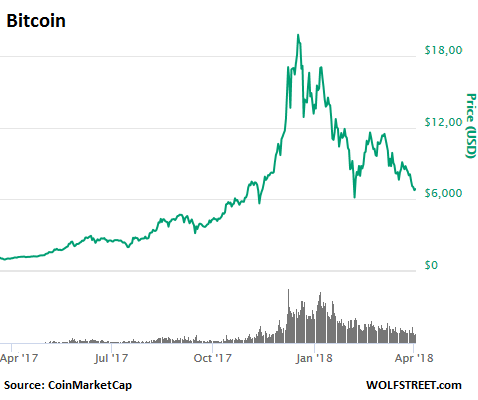
Bitcoin plunged 67% from its peak of $19,982 on December 17, to $6,573 at the moment. In just over three months, its market cap collapsed by $225 billion, from $336 billion to $111 billion. But as this chart shows, nothing goes to heck in a straight line (chart via CoinMarketCap):
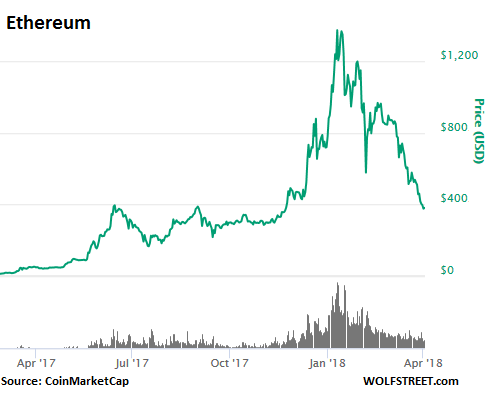
Ethereum plunged 74% from its peak of $1,426 on January 13, to $367 at the moment. Market cap collapsed by $102 billion, from $138 billion to $36 billion (chart via CoinMarketCap):
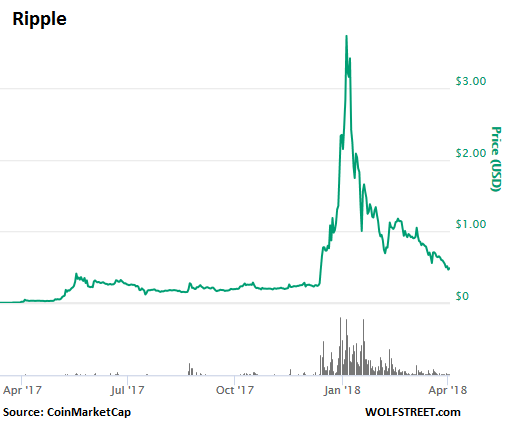
Ripple plunged 88% from its peak of $3.84 on January 4 to $0.47. Over the period, its market cap went from $148 billion to $18 billion. On March 28, when I last wrote about the collapse of Ripple, it was at $0.57, but has since plunged another 18% (chart via CoinMarketCap):
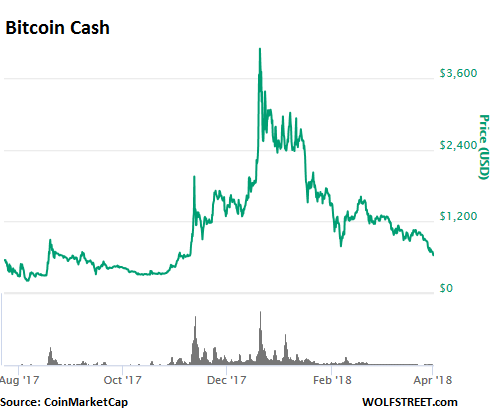
Bitcoin Cash plunged 85% from its peak of $4,138 on December 20 to $632 at the moment. Market cap dropped from $70 billion to $10.8 billion. It was split from Bitcoin last August. On November 12, I featured Bitcoin Cash, in an article subtitled “Peak Crypto Craziness?” I was observing, practically in real time, how it quadrupled in two days to $2,448. It is now back where that quadrupling had started out:
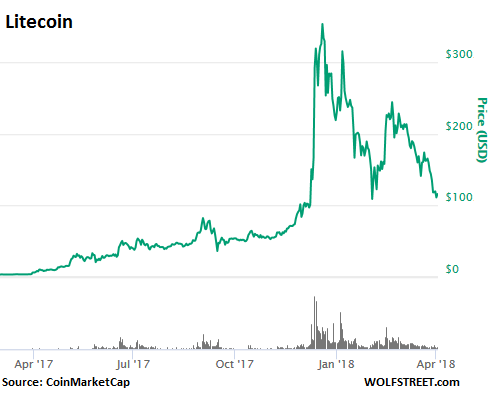
Litecoin plunged 70% from its peak of $363 on December 19, to $110 at the moment. Curiously, its founder admitted on December 20 that he’d wisely cashed out at or near the peak by selling his entire stake. The true believers who bought the tokens have been eating losses ever since. Market cap went from $19.7 billion to $6.2 billion.
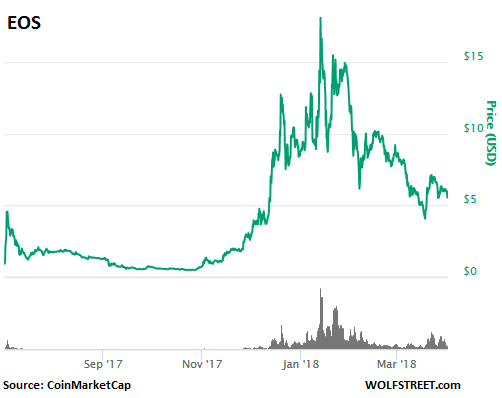
EOS plunged 71% from its peak of $18.16 on January 12, to $5.30. Market cap went from $11 billion to $4.1 billion: I pooh-poohed it on December 18 with “The Hottest, Largest-Ever Cryptocurrency ICO Mindblower.” The purchase agreement that buyers in the ICO had to sign – the ICO was not offered in the US due to legality issues – stated explicitly that holders of EOS have no rights to anything related to the EOS platform, and that they get nothing other than the digital token. Here is what the chart of this scam looks like:
And the blockchain technology (the distributed ledger technology) has nothing to do with cryptos. Cryptos merely use it. There have been a number of efforts underway for years to find large-scale commercial use for blockchain, outside of the crypto space. Those efforts have yet to bear fruit, though they may someday. All we have for now are small-scale experiments. Even if blockchain finds large-scale use, it will do nothing for these collapsing cryptos.

But the ancient theory that nothing goes to heck in a straight line still holds true, borne out by the charts above, and we can expect sharp volatility and a good amount of whiplash on the way there.

And here is an update on the hated “fiat” currency, the US dollar that cryptos were supposed to annihilate or at least obviate. Read… What Could Dethrone the Dollar as Top Reserve Currency?

Would you like to be notified via email when WOLF STREET publishes a new article? Sign up here.

A Symbol Of Freedom – The United States Military

It is our duty as Americans to honor those who protect our freedoms.

Eternity's avatarEternity

“To The Shores Of Tripoli” was a movie that was made about World War II, during that war. The Marines who are shown in the video are examples of those who train to fight for our nation. World War II was a very critical period of time in our nation’s history. To see the Marines as they are marching, is to also see, “freedom on parade.” If you will notice, Randolph Scott is the Marine Gunnery Sergeant who is leading the other Marines of lesser rank. The left heel of each Marine can be seen striking the ground, at the same time, in perfect cadence, at the beat of the drum. Watch how the marines make that “wide right turn,” with no one getting out of cadence, or “out of place.” Wow! Such an example of training and disciple! I have watched this video, many times, without ever getting tired…

View original post 1,076 more words

Will Turkey and Greece Have a War?

QUESTION: Message: Hi, huge respect for your eye-opening work. You mention that war is more likely to erupt in the middle east than Korea. Since middle east seems to be in a state of perpetual combat in different areas, do you think war could expand as Turkey is more & more openly hostile to Greece? The average Greek is no longer considering if it happens, more like when it will happen. Does Socrates provide a forecast on this?

Regards,

S, Athens.

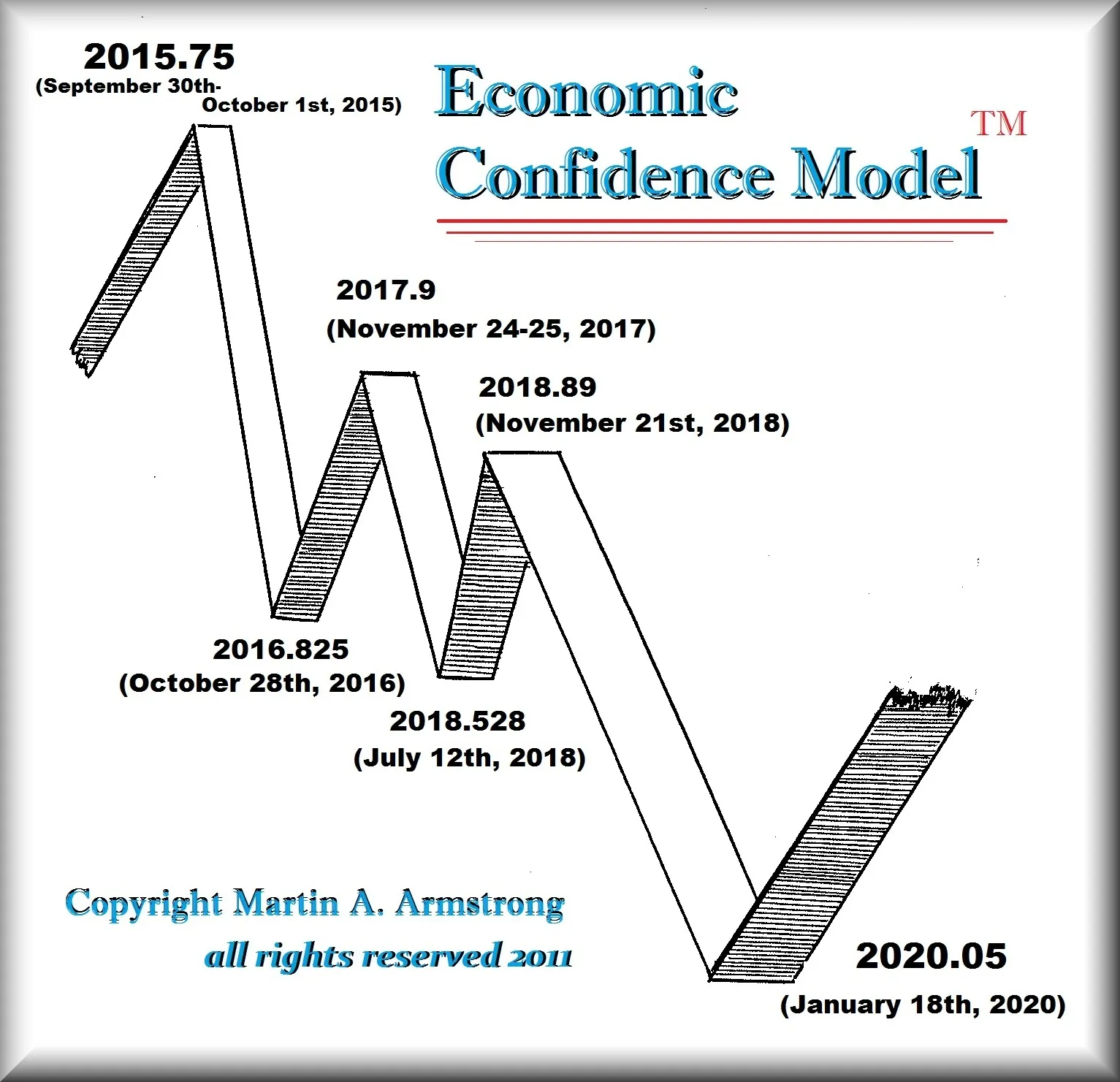
ANSWER: Actually, the primary target for a peak in any Greco-Turkish war will arrive in 2022. What we must understand is we have a major convergence between the Cycle of War and the Economic Confidence Model (ECM). What this means is the increased risk of geopolitical tensions are enhanced by economic downturns. This is what I have been warning about with the collapse of Socialism. As the endless promises of governments crumble to dust, politicians are faced with (1) the overthrow of their governments, or (2) create an external enemy to shift the blame from themselves. Therefore, as the economy turns down, interest rates will invert and rise when people no longer trust a government, and the fabric of the political-economy will be torn apart at the seams. This is historically the most dangerous point for at that moment, the government will turn to create external enemies.

When communism fell in 1989, the military establishment was no longer really needed. They needed to create external enemies to justify maintaining their position, status, and funding. Therefore, Russia continued to be the enemy of the USA simply because they needed one. When I would ask WHY was Russia our enemy if they were no longer Communist, the reply was dumbfounding: “Well they are Russian!” Even Ukraine was a power-play. The Eastern part of the country was ethnically Russian. The country should have simply been split north to south down the language border. Crimea was always a strategic port of Russia. If Japan told America to get out of Okinawa, the US response would be no different than Russia’s – America would occupy Okinawa. So why put sanctions on Russia for doing what the Americans or British have always done throughout history? The answer was just the military establishment needs an enemy – not peace. World peace means they are out of a job. They like those gold stars on their shoulders.

Therefore, as we head down into the economic abyss, the political necessity for war will be on the rise. Ergodan needs an external enemy. He is desperate for war and it will take two fronts – Kurds and the Greeks. He can easily stir the old pot of hate to retain power. This is what any politician does. Even Hillary during the election, as well as all the Democrats, stir the economic pot of class warfare to divide the nation just to get power. They also need that hatred of people who have more to win power. The people cheer and will one day storm the houses of the rich and will set them ablaze or drag them out and hang them. This is traditional and it is one primary reason class warfare is highly dangerous and undermines the foundation of any state. So this is what we face. Look at everything in that context and you will begin to see the conflicts deliberately created by the political class to retain power in ALL societies.

The first modern Greco-Turkish War following the fall of the Ottoman Empire is called the Thirty Days’ War, which took place against a rising Greek concern over conditions in Crete. This centered on the Turkish domination and where relations between the Christians and their Muslim rulers had been deteriorating rapidly. 1896 saw a rebellion on Crete instigated to a large extent by the secret Greek nationalistic society called Ethniki Etairia. They sought to fuel the historic resentment between the Christians and Muslims and they sought to create an opportunity to annex the island for the Greeks. Therefore, by the beginning of 1897, Greece sent arms to Crete to support a rebellion and revolution. On January 21, 1897, the Greek fleet was mobilized and in February Greek troops actually landed on the island proclaiming the annexation of Crete to Greece. The following month, the European powers imposed a blockade upon Greece to stop the arms shipments. The European powers feared that the whole of the Balkans would see vengeance upon the Turks.

The Greeks sent a force to launch an attack on the Turks in Thessaly (April). By the end of April, Greeks were overwhelmed by the Turkish army. The Greeks yielded to pressure from the European powers and withdrew their troops from Crete accepting an armistice on the mainland on May 20th, 1897. On December 4, 1897, a treaty was signed compelling Greece to pay the Turks an indemnity, to accept an international financial commission that would control Greek finances, and to yield some territory in Thessaly back to Turkey. Subsequently, the Turkish troops also left Crete, which had been made an international protectorate in 1898. Crete was finally ceded to Greece by the Treaty of London (1913), which ended the First Balkan War.

The second Greco-Turkish War occurred after World War I, when the Greeks attempted to extend their territory beyond eastern Thrace and the district of Smyrna. These territories had been given to Greece by the Treaty of Sèvres, August 10th, 1920. In January 1921 the Greek army launched an offensive in Anatolia against the nationalist Turks, who had defied the Ottoman government and would not recognize its treaty. In Greece, the war was followed by a successful military coup against the monarchy.

The Treaty of Lausanne concluded on July 24th, 1923, obliged Greece to return eastern Thrace and the islands of Imbros and Tenedos to Turkey, as well as to give up its claim to Smyrna. The two belligerents also agreed to exchange their Greek and Turkish minority populations. To this day, Turkey retains designs on regions it yielded to Greece.

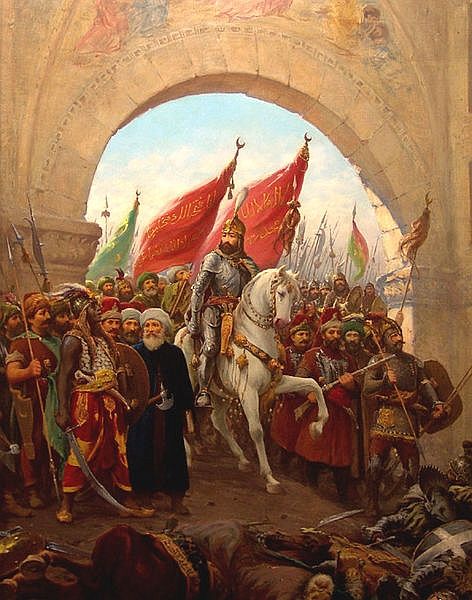
As the economy and hyperinflation continue in Turkey, the government desperately needs an external enemy. So yes. The tensions will continue to rise and this is seen as inevitable in Athens and the resentment goes back to the Persian invasion of Greece in ancient times. Even the culture of the Minoans were the origins of the Greeks. Anatolia was all Greek cities that filled modern Turkey. The fall of Constantinople in 1453 was the invasion of the Turks who were Muslim. So the traditional ethnic origin was Greek and the language of the Eastern Roman Empire ruled from Constantinople was Greek – not Latin.

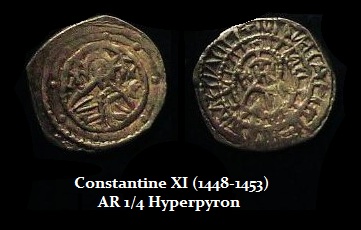
The last Emperor, Constantine XI (1448-1453), died in battle fighting the Turkish invasion. Beware November 2018. Things seem to begin picking up about then.

A Flourishing Hemp Industry Is Growing in Colorado – Foundation for Economic Education – Working for a free and prosperous world

Colorado farmers walked right through the door opened by hemp legalization. And despite the threat of federal prosecution, they started growing hemp. Since then, the fledgling industry has grown at a steady pace, despite ongoing federal prohibition.
— Read on fee.org/articles/a-flourishing-hemp-industry-is-growing-in-colorado/

Belief in College Has Become Religious – Foundation for Economic Education – Working for a free and prosperous world

The religious belief is that ambitious people have to attend college or they will be losers, or at least fail to realize their potential. No one knows what actually happens in college or why it’s supposed to make you more successful. Since the belief that college is needed for ambitious people is pervasive, ambitious people go more than less ambitious people. When employment or pay data are analyzed, they show that college goers do better on average than those who don’t. Of course. Because more ambitious people go to college more.
— Read on fee.org/articles/belief-in-college-has-become-religious/

Four more years of indoctrination at a steep price.