News
CS Lewis
C.S. Lewis in Wartime: Patriot & Prophet
Though C.S. Lewis had certainly been a patriot in the First World War, he was determined to be a prophet in the Second. In his speeches and his writings, he spoke directly to a people roused by the heat of battle and war, when morality and norms traditionally fail, even in the best societies…
 In the middle of England’s noble efforts against the Nazis in the first half of the 1940s, C.S. “Jack” Lewis bravely delivered a series of intellectual and spiritual public and radio addresses, and he wrote a number of essays, all dealing with the themes of war, civility, order, purpose, and ethics. Indeed, he gave several such series (orally and in written form), each asking the British to possess fortitude in their struggle against the German National Socialist threat, but, equally important, to understand why the war mattered so deeply at the level of Western civilization and humanity. Physical lives mattered, Lewis knew, but eternal souls mattered more. If the English should somehow mimic their enemy in the Second World War, all the sacrifices in the world would mean something far worse than nothing. They would amount to aiding evil itself, an evil that would now be associated with the British as well as with the National Socialists.
Lewis’s primary theme in these addresses and essays, of course, was not new. Socrates had told Crito the same, claiming that any adoption of evil—at even the most minute and fundamental level—corrupted the good, thus corrupting the individual soul as well as the harmony and order of society. Roughly at the time of Lewis’ death, Alexander Solzhenitsyn recognized that those Russians the Soviets murdered immediately upon arrest had the better deal. To survive arrest meant nothing but prolonged bitterness, hatred, self-doubt, self-loathing, and temptation in the Gulag. At least a person executed immediately died a martyr. The Gulag, rather, existed for the sole purpose of destroying the individual soul of each of its innumerable inmates. Few spiritually survived its tortures, especially in their desire to cheat death. They betrayed not only their neighbor, but themselves. All, of course, as the Soviets had desired in their millions of victims. All ideologies, the greatest of twentieth-century Russians, reminded us over and over, throve on the blood of their torture chambers and death camps.
What made Lewis’ argument so brave in the early 1940s, then, was not its originality, but rather its ability to remind the British what was eternally and always true: that only good begets good. In his speeches and his writings, he spoke directly to a people roused by the heat of battle and war, when morality and norms traditionally fail, even in the best societies.
Of course, Lewis himself had volunteered as an officer in the First World War, and he had served not only bravely, but with honor. As a Northern Irishman, he had been exempt from the British draft, but he fought for England regardless. Somewhat famously, the brilliantly liberally-educated man stood at his first hearing of sounds of warfare—bombs bursting and machine guns rattling—by proclaiming, in awe, “So, this is what Odysseus felt.” No one could accuse him of not being a patriot, though many might have said the same of Socrates, also a war hero, decorated for his bravery in many of the battles of his own youth. To be sure, patriots usually fare better in wartime than do prophets. During the war, Lewis sustained severe injuries to his back and internal organs. Lewis’s older brother, Warnie, also served in the British Army, fighting in World War I and remaining an officer for a full twenty years.
Though Lewis had certainly been a patriot in the first war, and he was determined to be a prophet in the second.
Lewis rarely, if ever, questioned his participation in World War I, seeing it, then and later, as a necessary war, in defense of the best of Western civilization. He regretted, of course, the massive loss of life, but he also understood war itself to be a brutal undertaking.
What worried him about the Second World War was the blurring of lines between civilization and military, and between the government and the military. Unlike the first war, the second inspired a goodly number of nobodies—to use Lewis’s understanding—to create parades, spectacles, and wastes of time to feel important and to enjoy, even if very briefly, a minute expression of power.
He will be, I think, a retired business man who, having few brains, finds the time hanging heavy on his hands, and, being a bore, is the greatest nonentity in his neighborhood. The cartoons almost draw themselves. We see [him] rising, say, in the Home Guard. We see how endless and useless parades, which are an unspeakable nuisance to his more intelligent neighbors, are a perfect godsend to [him]; here is something to do, here is self-importance. We see him doing things which no officer in the real army would be allowed to do—parading the men without greatcoats in winter while he wears one himself, or practicing ceremonial drill in wartime. We see him developing a disquieting tendency to theocracy and becoming fond of church parades, though he himself, perhaps, hardly knows his catechism.
Here, Lewis is nothing short of brutal when dealing with those whom he considers ill ordered in the good society. Having no meaning or purpose themselves, they willingly bring ruin upon all, in what Americans would later begin to call a “civil religion.”
Along with this blurring at the neighborhood level came the national government’s intrusion into the lives of its citizens at every level. In the first war, Lewis claimed, all new the national government’s war measures to be temporary. In the second, though, no one quite knew when the war measures would actually come to an end, and, even more disturbingly to Lewis, few seemed to care. Martial life was offering purpose to a floundering people, and that people might well accept such centrally-guided purpose for years to come. In almost every way, Lewis addressed these concerns in one of the finest science fiction and dystopian novels ever written, 1943’s That Hideous Strength (not published until 1945). As one female character notes in despair at a critical moment in the novel, the police were behaving so poorly, it was almost as though Britain had lost the war. Her attitude reflected Lewis’s own fears.
Unlike Russell Kirk, Robert Nisbet, and many other Americans of the 1940s, the Northern Irish Lewis was more than willing to accept national conscription if it was (or is) truly necessary to protect the nation state, but he preferred that the military remain distinct from both the national and political centers of power and the multitude of decentralized local associations.
“For the sake of our national existence we are ready to endure the loss of liberty. But we are not ready to endure it for anything less.” Lewis believed the failures of the British people came not merely from some national flaw, but, instead, for a failure of education to promote what was liberal and what was universal. He would develop these arguments repeatedly in books such as The Abolition of Man, not only one of the finest books of the last century, but one that is too great and important to deal with in this essay. Onward!
The Imaginative Conservative applies the principle of appreciation to the discussion of culture and politics—we approach dialogue with magnanimity rather than with mere civility. Will you help us remain a refreshing oasis in the increasingly contentious arena of modern discourse? Please consider donating now.
Tony Podesta offered immunity to testify against Paul Manafort (Tony is John Podesta, Hillary’s campaign manager’s brother)
The Best in uncensored news, information, and analysis
Radiation traces from Fukushima nuclear disaster found in Californian wine
The Best in uncensored news, information, and analysis
Source: Radiation traces from Fukushima nuclear disaster found in Californian wine
Backlash Against “War on Cash” Reaches Washington & China
They want a cut of every transaction.
Immigration and Politics
As Democrats Lurch Left, New Report Shows Americans Moving Right on Immigration
Following the lead of upstart New York congressional candidate Alexandria Ocasio-Cortez is Delaware’s Kerri Evelyn Harris, who is hoping her liberal leanings will propel her to victory over incumbent Sen. Tom Carper in the September Democratic primary. To achieve that goal, Harris has embraced the modern-day “progressive” platform and just publicly backed the idea of abolishing Immigration and Customs Enforcement (ICE).
“I believe that we need to get rid of ICE … then reallocate the funds that are being wasted on our current use of ICE,” Harris told Hill.TV, adding that she believed ICE “makes us less secure within our borders and internationally because people are concerned [about]how we’re treated one another.”
The pair join a growing chorus of Democrats on the local and federal level, particularly those with eyes on 2020, supporting the abolition of the agency responsible for enforcing immigration law in the interior, combating human trafficking and assisting in international terror investigations. Supporters insist their efforts are not akin to ending immigration enforcement, but they have failed to provide an alternative enforcement agency.
The reason behind this is clear even to immigration moderates.
“Democrats would quickly discover that turning simple campaign slogans into reform of ICE’s law enforcement functions will encounter resistance from activists who fundamentally oppose the deportation of undocumented immigrants,” write the Bipartisan Policy Center’s Cristobal Ramon and David Lapan.
Conversely, Americans’ views of immigration are edging toward more enforcement, not less.
“There is a new middle on immigration, and it is further to the right than many may realize. Most Americans believe the U.S. immigration system is broken, out of control, and antiquated,” begins a new report from the Bipartisan Policy Center.
That conclusion was reached after a year of conducting focus groups, interviews and a survey from Luntz Global, which finds a majority of voters opposing amnesty or providing a path to citizenship “for free.”
While Americans are proud of being a so-called “a nation of immigrants,” they also believe that the “government is mismanaging the current system, and that strong immigration enforcement is necessary to establish control over immigration.”
In addition, the survey found:
- Support for securing the border with the construction of a wall combined with technology and personnel;
- Immigrants should be able to communicate in English;
- Focus group respondents strongly believe immigrants are taking benefits that should go to Americans first.
Americans do not want more tired slogans and political posturing, they want solutions. And “Abolish ICE” is not the answer to either a broken immigration system or a party with no ideas.
‘It Was Like a War against the Church’
GDP Growth?
Is the US Economy Really Going to Pop 4.5% in Q2?
by Wolf Richter • Jul 22, 2018 • 49 Comments
At least one of them is very wrong: Atlanta Fed GDPNow v. New York Fed Nowcast.
On July 27, the Bureau of Economic Analysis (BEA) will release its “advance estimate” of GDP growth for the second quarter. Based on preliminary and incomplete data, this number is what everyone puts under the microscope.
On August 29, the BEA will release its “second estimate” for Q2 GDP growth, which will include more data. On September 27, the BEA will release its “third estimate.” In future years, it will further revise GDP growth as more data becomes available or gets revised. Only China releases a GDP growth rate that is perfect on day one, is always very high, comes out before the US release, and never needs to be revised.
But in the US, even as the revised numbers get more accurate, the least complete and reliable “advance estimate” gets the most media attention.
Outside the BEA, an army of economists struggle to estimate what the “advance estimate” of GDP growth is going to be – including in the Federal Reserve machinery. The Atlanta Fed with its GDPNow and the New York Fed with its Nowcast just came out with very different forecasts.
The Atlanta Fed is out with a huge GDP growth number for Q2, after raising it from already high levels in early July: Its nowcast hit 4.5% on July 16 and stayed there on July 18 after real consumer spending for May, industrial production, real private fixed investment, and real private inventory investment data were released.
These nowcasts are supposed to get more accurate as data for the quarter accumulates. The quarter is over, and June data is starting to be included – though June’s consumer spending data, a biggie, is still missing:
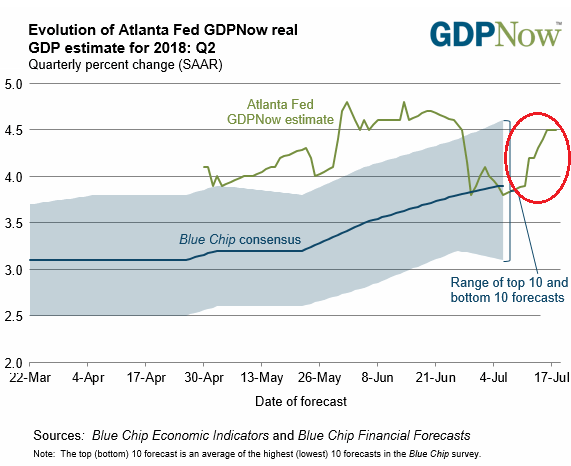
The GDP estimates of the “Blue Chip” economists surveyed by the Atlanta Fed are in the range between 3.3% and 4.6% (shaded area). So the Atlanta Fed’s 4.5% is at the top of the range of the Blue Chip economists. That says something!
Annual rate means that if the economy grows for four quarters in a row at the rate of the current quarter, the total annual growth would be 4.5% compared to the prior year.
How big is a 4.5% seasonally adjusted annual GDP growth rate? This is a huge number for the US. The last time the US economy grew at a 4.5% annual rate was…. Well, we have to dig deep into history… let’s see, back in the day… the Clinton era… in Q2 2000 (5.2%):
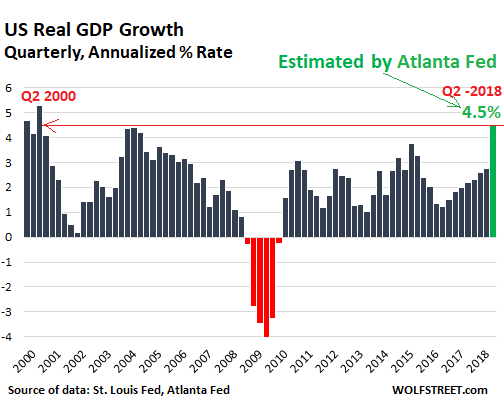
So the Atlanta Fed’s nowcast is truly an outlier – practically a miracle.
However, the New York Fed’s nowcast is raining on this parade. Released every Friday, it peaked on June 1 at 3.26% and has since been in decline, going the opposite direction of the Atlanta Fed’s GDPNow. Friday’s estimate dropped to 2.69%, the lowest in the series for Q2:
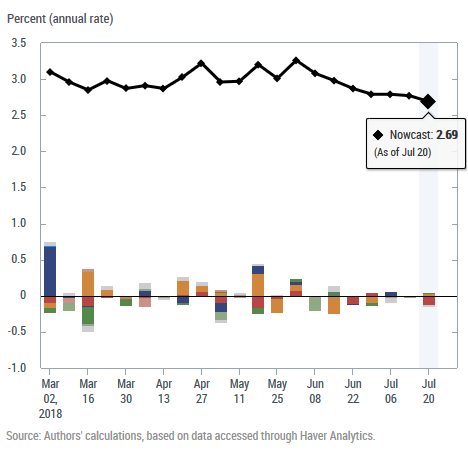
The colored columns in the chart above show the impact of each broad category of data on the Nowcast. And since the beginning of June, there were more and bigger negatives than positives. Not very inspiring.These are the broad categories:

So now big is an annualized rate of GDP growth of 2.7%? It’s still strong given recent growth patterns, but it’s smaller than the growth in five of the quarters since the Financial Crisis, including Q1 2018. While the Atlanta Fed’s GDPNow is a true outlier, the New York Fed’s nowcast (green column) is well within the post-Financial-Crisis normal-ish range:
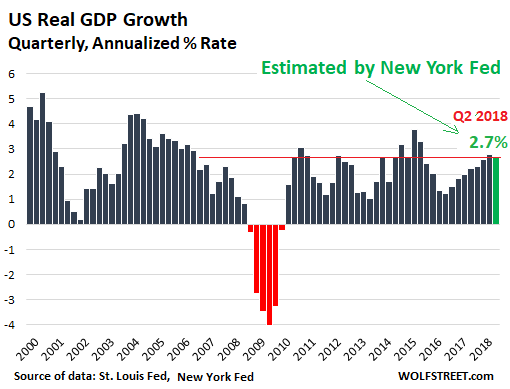
So which estimate will be closer to BEA’s “advance estimate” when it’s released on July 27? From where I sit, the New York Fed’s estimate looks more realistic than the Atlanta Fed’s estimate: 4.5% is just a huge number for the US economy, given the growth history of the past 20 years. Frankly, even hitting the New York Fed’s 2.7% growth rate would be good. We will find out on July 27. Meanwhile, I’m wondering, why do they differ this much?
One possibility is that the economy in Q2 hit it out of the ballpark, and only the Atlanta Fed’s model saw it. But I doubt that.
Another possibility is inflation. The annualized GDP growth rates are adjusted for inflation – so “real” GDP growth rates. Consumer price inflation has been rising sharply. In June, inflation as measured by CPI, rose 2.9%, the biggest increase since February 2012. The Atlanta Fed’s model might not have fully captured the impact of inflation.
The reason I’m wondering about this is because “real” consumer spending, which accounts for nearly 70% of GDP, rose only 2.6% in April year-over-year, and 2.3% in May. June’s data will be released later this month. But with real consumer spending growing at only 2.3%, it’s nearly impossible to get to 4.5% real GDP growth.
So for now, the Atlanta Fed’s GDPNow estimate of 4.5% GDP growth in Q2 is a mystery seeking an explanation.
How the “Yield Curves” Stack Up in central-bank manipulated bond markets. Read… Which Yield Curve “Inverts” First? US, Japan, Germany, or China?
Would you like to be notified via email when WOLF STREET publishes a new article? Sign up here.
Expert: Trump Poised To Take Control Of The Federal Reserve
Expert: Trump Poised To Take Control Of The Federal Reserve
— Read on www.infowars.com/expert-trump-poised-to-take-control-of-the-federal-reserve/
Truth News Headlines July 23, 2018 – American Intelligence Media
Truth News Headlines July 23, 2018
— Read on aim4truth.org/2018/07/23/truth-news-headlines-july-23-2018/


You must be logged in to post a comment.