So Much for Openess at the FBI

How the FBI Silences Whistleblowers

Speaking truth to power has ruined Darin Jones, a former FBI contract specialist who reported evidence of serious procurement improprieties. He should be the last federal whistleblower victimized, writes John Kiriakou.

By John Kiriakou
Special to Consortium News

The idea of “whistleblowing” has been in the news a great deal.

Is the anonymous author of a recent New York Times op-ed eviscerating the president a whistleblower?

Is the victim of an alleged sexual assault by Supreme Court nominee Brett Kavanaugh a whistleblower?

I’m fortunate to have access to the media to talk about torture after blowing the whistle on the CIA’s program. I think Ed Snowden, Tom Drake and others would say the same thing about the aftermath of their own whistleblowing.

Cost of Doing the Right Thing

The problem is that we are the exception to the rule. Most whistleblowers either suffer in anonymity or are personally, professionally, socially and financially ruined for speaking truth to power. Darin Jones is one of those people. He’s one of the people silenced in Barack Obama’s war on whistleblowers. And he continues to suffer under Donald Trump.

Jones was an FBI supervisory contract specialist who in 2012 reported evidence of serious procurement improprieties to his superior. Jones maintained that Computer Sciences Corporation (CSC) had been awarded a $40 million contract improperlybecause a former FBI official with responsibility for granting the contract then was hired as a consultant at CSC. Jones said, rightly, that this was a violation of the Procurement Integrity Act. He made seven other disclosures alleging financial improprieties in the FBI, and he was promptly fired for his troubles.
Remember, the United States has a Whistleblower Protection Act.  Any federal employee who brings to light evidence of waste, fraud, abuse, illegality, or threats to the public health or public safety is protected under federal statute.

The FBI didn’t care, though. Jones was a troublemaker. He was talking about his fellow FBI agents. And he had to be silenced.

Immediately upon his firing, Jones appealed. He was not reinstated, however, because he had made his revelation to his supervisor and not to one of the nine people on the FBI leadership-approved list of who could hear a whistleblower complaint. Jones appealed again, beginning a more than four-year odyssey.

Sen. Chuck Grassley (R-Iowa) is the champion of whistleblowers on Capitol Hill, whether you like his politics or not. Jones contacted Grassley and asked for help. His dismissal was clearly retaliation for his revelations and was illegal, according to the whistleblower protection law. Grassley agreed and wrote three separate letters to then-FBI director James Comey and then-Deputy Attorney General Sally Yates. None were answered.

Grassley urged the Justice Department to reinstate Jones, saying that his dismissal was a violation of the Whistleblower Protection Enhancement Act of 2016, which strengthened the original whistleblower protection law. He added that when Yates appeared before his Senate Judiciary Committee for her confirmation hearings earlier in the year, she promised “to improve the process for adjudicating claims of retaliation, including expanding the list of persons to whom a protected disclosure may be made.”

She never did that. In fact, Yates ordered the director of the Justice Department’s “Professional Misconduct Review Unit” to write to Jones and to tell him, “The Deputy Attorney General’s review is complete and her decision is final. Your case is no longer pending. You should not expect to receive any future communications that you or any other organization or individuals may submit with regard to your whistleblower reprisal case.” In other words, the official policy of the Justice Department was to ignore the law and to give the Senate Judiciary Committee chairman and the whistleblower himself the middle finger.
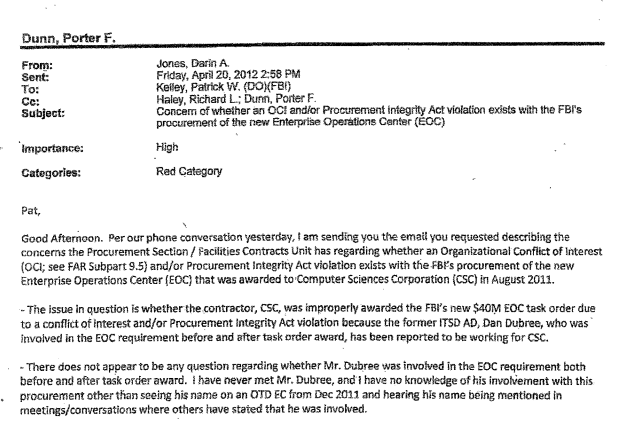
The FBI’s response was equally bad, albeit predictable. The FBI’s Office of the General Counsel wrote to Jones, “The FBI has advised you that it will not conduct further investigation into your allegations that the FBI removed you from employment because you reported a compliance concern and retaliated against you in violation of applicable whistleblower retaliation protection regulations. The FBI has met its legal obligations and considers this matter closed without any basis for further review or reopening. Please be advised that the FBI will not respond to any additional correspondence or emails related to or arising from the termination of your employment.”

That’s another middle finger.

Note also that the FBI refers to “whistleblower regulations.” It’s not a regulation. It’s a law. And the FBI, too, has to respect and follow the law even when they don’t want to.

End Victimization of Whistleblowers

The bottom line here, though, is that Darin Jones did the right thing.  He did the honorable thing. He did the ethical, legal, and moral thing. And he paid for it with his career.  Like other federal whistleblowers, he’s ruined financially. Friends and family members have walked away from him. He can’t find a job. I can tell you from firsthand experience that the psychological weight of the fallout from whistleblowing is sometimes too much to handle.

Jones’ friends and supporters are creating a GoFundMe campaign to help him through this horrible period.

We also need to keep up the heat on the FBI, the CIA, NSA, TSA, and every other governmental organization that victimizes whistleblowers.

We have to support Chuck Grassley and others on Capitol Hill who are trying to protect whistleblowers.

We have to force our own elected officials to do the same. After all, they work for us.

Our goal should be a simple one. Work hard to ensure that Darin Jones is the last federal whistleblower to be treated this way.

John Kiriakou is a former CIA counterterrorism officer and a former senior investigator with the Senate Foreign Relations Committee. John became the sixth whistleblower indicted by the Obama administration under the Espionage Act – a law designed to punish spies. He served 23 months in prison as a result of his attempts to oppose the Bush administration’s torture program.

If you value this original article, please consider making a donation to Consortium News so we can bring you more stories like this one.

2762

Muslims and Mental Illness

The Muslim veil of silence on mental health

To speak about mental suffering is seen as rejecting God’s plan


Earlier this year in the Grand Mosque in Mecca, a man leapt from the roof of the gleaming building to his death. He had killed himself. His leap was, inevitably captured on video, along with the collective gasps that stabbed the air as he jumped. News outlets in Saudi Arabia identified him as a 26-year-old Frenchman.

No one can be certain of his motives, but as British Muslims on social media began to talk about it, the suicide acquired a significance beyond the act itself. Suddenly, a place of worship and sanctuary became the cornerstone of a discussion for which no-one seemed really ready. One rooted in issues of cultural trauma, family, honour and an overzealous belief in prayer being the solution to all problems.

There had been uncomfortable attempts by the community to grapple with the issue of mental health previously but this one moment – of a man plunging to his death before what Muslims regard as God’s House – became a signal that silence could no longer persist. People had to talk.

For too long the response of British Muslims, particularly those of south Asian heritage, to such stories has been problematic. Though some have spoken poignantlyabout the problem, others have underlined the ignorant attitudes prevailing within the community.

Further reading

Poor mental health is bad for the economy as well as for the person

By Charlotte Pickles

In their eyes, the dead man had committed an abominable act directly before God. The mention of mental illness was not enough to stir them to pause and reflection. As they saw it, he had stained himself in the worst way, in an inexcusable manner.

Sadly, this unforgiving view is why many British Muslims struggle to discuss mental health. The man wasn’t seeking redemption or excuses for his sins, but probably hoping for an end to his suffering; he may have wished God’s House to be the last thing he saw on earth. There’s something deeply saddening in that; worse still is the fact that so many refuse to attempt to understand his case and others like it.

There was little compassion for this man’s suffering – even though it led to his death. Many Muslims see sin as a human flaw, but mental illness is not a flaw in that sense. It’s not a human weakness conditioned by our own behaviours and actions, but something uncontrollable.

The absence of compassion is a symptom of the wider struggle to discuss mental health within British Muslim families, which arises from a toxic fusion of religious misunderstanding and cultural values. Islam supposedly tells people life is a test and that they should embrace its sharp edges and desolate moments. To speak about mental suffering, in that interpretation, is to reject God’s plan and not to have faith in religion to solve the pain.

Further reading

‘The Inner Level’, inequality and why sad is the new hip

By Richard Godwin

It doesn’t matter that that pain can leave you feeling like you’re drowning in constant black waves. Faith, and particularly prayer and its power, is the log you are supposed to hold on to stop you from being swept under. Dr Ghazala Mir, a researcher at Leeds University, argues that “This stigma does involve the idea that maybe if you need treatment, there might be something wrong with your faith identity in the first place.”

This is the retort that has greeted many who try to discuss the issue, or to argue that prayer alone isn’t enough to solve mental illness. People are told their weak faith is the cause of their depression – yet depression can affect enthusiasm for anything, including praying. There is fear and guilt in thinking prayer won’t solve the problem. So when you pray and find the solution slipping further away, you feel helpless. Your despair spirals.

Religion is often entwined with culture; most British Muslims of a south Asian background are influenced by their cultural roots simply by the differences from Muslims of other ethnic backgrounds. In particular, a tight-knit family structure is central to their identity. There is a constant demand to protect a family’s reputation and not to disappoint, to be what religion and culture demands, and avoid what the community gossips about.

Further reading

The bureaucratic fracturing of government can destroy lives

By Peter Franklin

For women, the ties and obligations to family are even tighter. Secrecy, fear, shame and honour mean everything. Reputation is everything, especially for a woman, because – to put it crudely – it can lower her value for marriage in parts of the community. Stories of ‘honour’ violence and supernatural possession are examples of the misogyny they face within families. The concept of demonic possession, in particular, affects women who exhibit signs of mental illness; the prescribed solution requires an exorcism but damages their name and status irrevocably. And of course, how as Muslims can you deny that demons exist?

I lost years of my life to mental illness. It was always there like a shadow, returning when I least expected it. After years of struggle and grind I thrived in university, feeling as if I had been unshackled. But my religion became an obstacle, deepening the problems. Faith strangled me with doubts, shame – and terror that I was sinning for refusing to accept prayer as the only road out of this gloom.

I lost count of how many times I stood on a train platform thinking there was a way for these thoughts to stop. Maybe it was the fear of God that stopped me from acting then, but it was also the fear of God that for years stopped me exploring solutions beyond prayer. Reconciling with roots I felt were holding me down but still couldn’t break from, was and remains a struggle.

Further reading

Young British muslims are putting their money where their mouth is

By Katie Harrison

Finding a solution to mental illness is not easy, especially to those of us suffering from it for years. Understanding it is like wading into an ocean of bottomless depths, or as a friend put it, “trying to keep a door open with a piece of string.” Perhaps it’s an inner war with no end that we will always be fighting. That’s how it feels.

But cultural values of family honour and pride, as well as religious demands of confidence in God, should not become deterrents for talking about illness.The mental health charity Mind has begun working with British Muslim communities to tackle this, reporting positive feedback.

What has certainly helped is exposure to western culture. As the older generations of British Muslims were more swayed by their cultural roots, younger generations are more influenced by a British culture which has started to challenge the stigmas around mental health, particularly the gender stereotypes which prohibit men – and women – from displaying emotional vulnerability

Will things change? If the traditional ‘stiff upper lip’ is now allowed to tremble. I can only hope that the same thing will happen within my community. The shameful silence imposed by my religion cannot persist.

A Massive Economic Failure?

The West is one crash from chaos

Western countries aren’t resilient enough for another financial crisis – unlike China


Elites throughout the West are grappling with the rise of populist parties and figures challenging the turn of the century consensus. They haven’t seen the half of it. The sober fact is the entire West is just one financial crisis away from chaos.

If that seems exaggerated, consider the facts. Extreme economic hardship almost always produces dramatic political changes. The economic collapse following the Great Depression ushered in fascism throughout Central and Southern Europe and social democracy in most other states.

The stagflation of the 1970s gave rise to Margaret Thatcher and Ronald Reagan, whose apparent political and economic successes nudged the rest of the West toward some form of neoliberal economics. Even in the late 1990s, nations that experienced extreme deprivation because of the collapse in the price of oil, such as Venezuela and Russia, overthrew their established political orders in favour of undemocratic authoritarian regimes.

This pattern even held true following the Great Financial Crisis of 2008. The economies of Greece, Ireland, Iceland, and Spain essentially collapsed under the strain. Each has since either elected a populist-led government (Greece), or seen the share of the vote of the pre-crisis established parties drop by between one-quarter and one-third. The slow-growth countries of France and Italy have both ended the domination of their politics by traditional Right-Left parties; elsewhere the old duopoly is hanging on by a thread, often in coalition with one of the new, populist parties.

Further reading

Ten years on from the crash, the most important banking reform has still not been enacted

By Liam Halligan

The events of 2008 also upended politics in the Anglosphere. The United States and Great Britain were hardest hit, each experiencing large increases in unemployment and expensive bank bailouts. Each has seen the Right challenged by anti-immigration and anti-globalist forces, and each seen the Left rise to obtain or battle for control of the leading centre-Left party. Even placid Australia, whose economy declined after 2008 but never dropped into recession, is seeing record numbers of voters embracing anti-immigrant or other protest parties.

All of this is well known, but the role of economics in these developments is still under-appreciated. According to the OECD, 28 of the 32 member countries on which it has data increased their debt-to-GDP ratio between 2007 and 2018. Countries that experienced deep downturns dramatically increased their debt, even to the point of doubling it (Great Britain, Iceland) or nearly tripling it (Ireland, Spain).

Virtually every major economy now has debt-to-GDP ratios at the level that, pre-2008, would have sent alarm bells ringing in financial markets. Among wealthy economies, only Germany, Switzerland, and a couple of Nordic countries are close to pre-Crisis debt levels. As rich as they are, they cannot bail out the world should another crash occur.

Further reading

Four reasons another crash is on the cards

By Daniel Gayne

In essence, wealthy countries throughout the world bought off political convulsion the old-fashioned way, by borrowing massive amounts of money to fund high levels of government consumption. Individual nations might have the financial capacity to address mild or local downturns, but the free world does not have the cash to bail itself out again. Given what we know from history and recent experience, the political reaction to a combination of crash and austerity will be swift and severe.

There is an alternative to a financial crash followed by political upheaval, but it carries its own political risks. China’s economy is now the largest in the world, and while its household and business debt is high, its formal government debt is not. China’s central bank holds over $3 trillion in hard currency reserves. Assuming that a financial crash in the West does not completely crush the Chinese economy, one can easily imagine Beijing absorbing some of its own domestic debt defaults while bailing out strategic countries that are now part of the Western alliance.

Does anyone think that newly-elected populist governments – or even pre-crash established ones who see the writing on the wall – would turn down offers of low-interest loans from China to avert total collapse? Does anyone think that the longer-term ramifications of that would stop those nations from signing on the dotted line if an equivalent offer were not forthcoming?

These considerations should cause Western governments to sit up. They need to start serious economic reforms now if they want to avoid the risk of everything blowing up.

Further reading

Ten years after the crash, we should still be terrified

By Peter Franklin

There are only three ways to get a debt problem under control. The first is devaluation – if the currency is worth less, then the value of the debt held by creditors would be reduced. Devaluation also can spur growth, as the costs in the devaluing country are suddenly cheaper in terms of the purchasing country’s currency.

The second is inflation – again, with high rates of inflation, the dollar amount of the debt held drops in real terms, making it in theory more affordable if all else remains equal. The problem with both of those remedies is that all else rarely remains equal. Inflation in particular erodes confidence in the future, which erodes investment. That in turn reduces growth, which reduces nominal GDP in future years and thus undermines a country’s ability to service its debt.

Devaluation only works if one is a first-mover country, gaining a relative advantage over other countries that do not devalue and thus spurring growth. If all major countries devalue, or if a small country’s devaluation is then followed by a very large country’s move, the advantage is cancelled and the expected future growth does not occur.

Further reading

As China pitches for reserve currency status, the era of US hegemony is ending

By Liam Halligan

The third option, increasing economic growth without currency debasement, is hard to implement. Orthodox prescriptions from the Right – labour deregulation, lower marginal tax rates, and so forth – always either worsen the debt problem initially, prove politically difficult to pass in the face of opposition from vested interests, or both.

Orthodox prescriptions from the Left – higher levels of public spending and, often, increasing taxes on capital – also produce initially worse financial results and resistance from special interest groups. The solution the Italian populist government has just hit upon – to do both simultaneously – is even riskier financially, as the doubling of Italian government bond yields since the government was formed in May demonstrates.

And so the West slouches on, hoping the centre will hold. It might: one can never predict the future with any certainty. But the warning sounds are present, and growing more urgent, for all who have ears to hear.

Further reading

Chinese capital flows – the ‘dragon energy’ of globalisation

By Peter Franklin


Great Email Security

This personal server lets you keep your emails entirely in your control

If an email service is free, then your data is what’s being sold. The new Helm server makes sure only you have access to your emails.

[Photo: Helm]

A few years ago, two software engineers took a look at the state of privacy online. Edward Snowden had recently revealed that the NSA was reading the emails of American citizens. A small group of companies controlled the majority of the internet, as they do now, by offering free services as they gathered data about the people using them. The engineers, who had just helped take a security company called Rapid7 public, decided to leave their jobs to work on a better way to protect privacy; three years later, they’ve launched a new product in an attempt to address the problem. Called Helm, it’s a private email server that you can use in your home–an alternative to free cloud-based services, like Gmail, that make it impossible to control your own data.

“One of the things that became really evident to us was how the vast majority of people were living more and more of their lives online, and as we live our lives online, we didn’t really have much of a choice but to trust a handful of very large and powerful tech companies,” says Giri Sreenivas, cofounder and CEO of Helm. “All of that data and all of those online behaviors were being centralized in a way that made it very easy for governments to conduct this type of surveillance.”

[Photo: Helm]

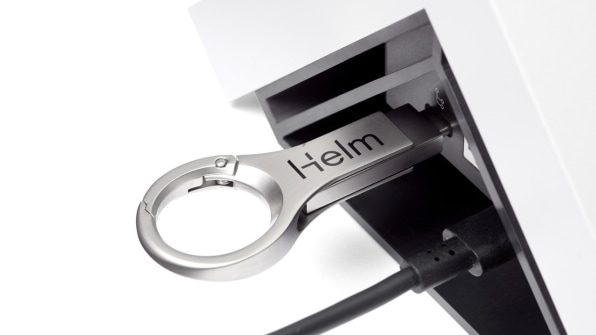
The new server is a small device that stores email, calendar entries, and contacts, and can be used with an ordinary email app on a desktop computer or a phone. The data, which is backed up offsite, is encrypted, and only the user can decrypt it. It takes three minutes to set up, the designers say, and automatically updates itself to stay secure.

“It creates a different paradigm,” says Sreenivas. If the government wants to read all of your emails, they’ll need a warrant to come inside your home. “They need to go through the customer to get access to that data.” Google’s lawyers might stand a better chance of stopping a government warrant for your emails, but at least you’d know that your emails weren’t secure.

The server is designed to protect users both from government surveillance but also the more mundane but equally invasive threat of companies mining data to sell to marketers. First, Sreenivas says, email addresses tend to be linked to everything else you do online, from banking to dating; if you control your own email, it’s harder for companies to see the full picture of your digital life. Second, they can’t easily scour what you’ve written. For instance, Google says no one reads your emails, but there have been some lapses, and your email is still associated with things you’ve watched on YouTube, which still allows for targeted ads. Other email services, like Yahoo and AOL, still do scan your email. It’s true that if you’re sending an email to your grandmother’s Yahoo account, Yahoo could still potentially gather data from that exchange. But “for an organization to build a profile of you as an individual based on who you communicate with, it’s much more difficult, if not impossible, in comparison to a centralized store of information like your actual email account,” he says.

“If you don’t want data to end up in the hands of marketers, then I think you do have some reason to be a bit concerned about some free services that are used…if you have your data, then you have a lot more control over it,” says Justin Cappos, a cybersecurity expert and computer science professor at New York University. “For most people, the bargain you get with something like Gmail is they manage all of the storage, you don’t have to worry about something like a hardware failure.” The new server has 120 gigabytes of storage; if something happens to the server, Helm will overnight a new one, though that might mean being without new emails for half a day.

[Photo: Helm]

One challenge to adoption may be price: The Helm server is launching at $499, and after a year, users will have to pay a $99 subscription fee. And there are obvious benefits to having a major corporation fixing bugs, blocking spam, and otherwise maintaining your email server for you. So Sreenivas says that the company will initially target engineers and security and gadget enthusiasts in particular, but he believes that the market is wide. “We think people are understanding more and more that there is no such thing as ‘free,’ that ‘free’ email services rely on profiting off your personal data with third parties, with all the associated risks,” he says. “As more and more data breaches occur, people will want their personal information closer to home, especially as the convenience of doing that increases.”

[Photo: Helm]

If people do move away from free services, it could change marketing. “We believe that there’s an opportunity where people have control to make much more selective decisions about how their personal information and how their online behavior can be exposed,” he says. “We’re not against people being able to trade information about them in exchange for some sorts of benefits. In many ways this has contributed to how the internet has grown as fast as it has.”

Someone might visit a website, be asked to answer a few questions about themselves, and then be able to read five articles in exchange, for example. The fundamental difference from today’s system is that users would be actively consenting to share their data. “We feel the pendulum swung too far,” he says. “So I envision a future where advertisers actually come to individuals who have control over the data.”

“I don’t know if that’s a future that’s three years from now or five years from now or 10 years from now,” he says. “But I do believe that what we’re building is a fundamental building block to be able to get there.”

Google and Green

Google’s new long game: 100% clean energy all the time

Buying enough clean energy to make up for all the dirty energy you’re using is one thing; using all clean energy 24/7 is another.

Google’s new long game: 100% clean energy all the time

Our time to move away from dirty energy to green sources is limited. Federal governments can’t be relied upon to push the conversion–especially not the one in the U.S., which is actively working against large-scale adoption of green energy. Much of the progress we’ve seen so far has come from big corporate energy buyers demanding carbon-free power. There is an ecological motivation, but it’s also driven by a desire to get in on the falling cost and high cost predictability of renewable energy sources like wind and solar.

The largest corporate buyers are big tech companies that rely heavily on global networks of large power-hungry data centers, storing and serving up most of the internet’s digital content. Google is currently the world’s largest buyer of renewable energy, in its various forms—over 3 gigawatts—according to a March report by Bloomberg New Energy Finance. This particular Fast Company article comes to you via a server hosted by Amazon Web Services, the world’s largest cloud provider and No. 2 on Bloomberg’s list. (Microsoft, Apple, and the U.S. Department of Defense round out the current top 5.)

With its sizeable purchase of renewables, Google says it’s currently matching all of its total energy use with clean energy sources. But when you hear a company like Google say, “We’re 100% renewable energy,” it usually means that it is, on balance, buying as much clean, renewable energy (wind, solar, etc.) as it is consuming unclean, non-renewable energy (coal, natural gas, etc.) in a given year. That’s not the same as directly “powering” their operations with all renewables all the time.

Companies typically can’t generate enough power for a data center from an onsite solar or wind farm; they have to connect to the local power grid like everyone else. And the local utilities that run the grid get their power from a mix of sources, some dirty, some clean. The energy buyer can’t choose to buy only the electrons from the grid that were generated from clean energy sources.

Instead, buyers offset their energy use. Many companies sign virtual power-purchase agreements whereby they buy renewable energy credits, financial instruments that certify that a certain amount of green energy has been added to the electric grid. In some markets, corporate customers can go directly to a green energy wholesaler to get their power. Big buyers like Google, Apple, Microsoft, Amazon, and Facebookactively organize as well as invest in new clean energy projects in markets where they operate, so there’s more of the stuff available to buy.

But these tactics are just the first moves in a long game. In a new research paper, Google begins to look at an ultimate goal: converting its data centers to 100% green energy—all day, every day. And it provides a framework for achieving the real-world steps needed to get there. “Achieving 100% renewable energy is just the beginning,” Michael Terrell, Google’s head of energy market development, told me. “We’re keeping our eyes on the prize, and that is getting to carbon free for every hour of the day for every location.”

What a zero emissions grid might look like

This entails a different way of measuring progress. Buying enough clean energy to make up for all the dirty energy you’re actually using is one thing, but matching energy needs with clean energy resources all day, every day is quite another. The scientists call the latter “spatial and temporal specificity,” and that’s what Google is starting to think and talk about.

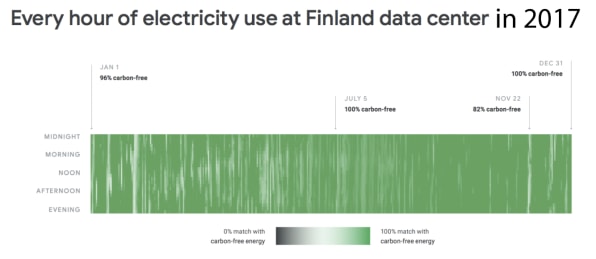
To express progress toward that goal, Google has developed a heat map graphic to show how much clean energy is being used at various times of the day throughout the year.

[Image: Google]

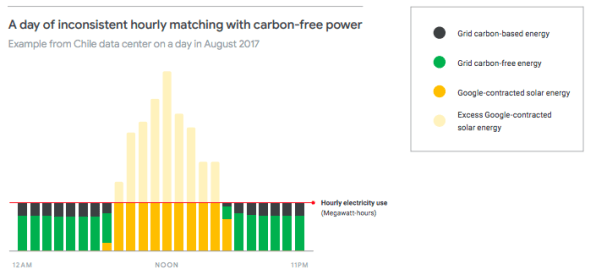
The power needs of Google’s data centers are fairly predictable–that is, they run all the time, and they require lots of energy all the time. But green energy production is far less constant (the sun that heats solar panels goes down every night), and far less predictable (who knows when the wind will blow?). The availability of green energy is also subject to the seasons and to the geography of the place where it’s made.The value of spatial and temporal measurement is that it leads to the creation of a model showing how a specific data center on a specific grid might get to that goal of 24-hour, 7-day-a-week renewable power, said Jesse Jenkins, a postdoctoral environmental fellow at the Harvard Kennedy School of Government. The model might propose a careful mix of green energy types, depending on their availability and location. It might propose a specific type of transmission network and/or the number and capacity of battery storage facilities needed to supply power during off-peak periods.

[Image: Google]

Such models could provide a framework for the way large energy buyers might deal with energy sellers in the future. “It could lead to the outline of a new kind of corporate power purchase agreement, a kind of contract that would define how to produce enough renewable energy to meet needs,” said Jenkins, who is not involved in the Google effort.To understand the company’s goal, consider the LEED rating system for green buildings. Apple’s new Apple Park facility, for example, was awarded a Platinum LEED rating for its use of natural cooling, efficient ventilation, and onsite solar panels. “What Google is doing is setting up a new Platinum Level for corporate institutional power purchases,” Jenkins told me.

Thinking about spatial and temporal variability has become important for policy analysts and engineers, but by talking in those terms, Google may be able to reframe the problem for other big power buyers, utilities, and people in the financial communities.

“They’re trying to raise the bar and say, ‘Hey if we really want a model for what a zero emissions carbon grid could look like, then we really have to figure out this model,’” Jenkins said.

Google’s Terrell told me that making meaningful progress toward the goal of 24/7 green power will require cooperation from other people and organizations. “We don’t have all the answers,” he said.

State regulators will have to do the work of clearing away barriers to the purchase of 24/7 green power and should help in setting prices for renewable sources. Further development on energy storage technology will be needed, as well as investment in green energy sources including nuclear. And buyers, utilities, and financial institutions must work together to create new ways of contracting for 24/7 green power.


Of course, building models isn’t enough. Google should use its largesse to push the envelope and apply real pressure to competitors, regulators, utilities, and financiers to move more aggressively. Google should use some of its growing army of lobbyistsand influencers in Washington, D.C., and other foreign capitals to push for more incentives that might move corporations and people toward green energy.

It’s a very good time for the advertising giant to push the green envelope. Lately, its reputation has been sullied, especially in the U.S and Europe, by a growing understanding among consumers that the company makes its billions on the fuel of consumers’ personal data. And it’s made serious trust-eroding mistakes in judgment. The company recently admitted to not disclosing sooner a longstanding security flaw that exposed the profile data of millions of Google+ users with third-party app developers without users’ permission. Some of Google’s own employees have recently revolted against the company’s contracts with the military.

So it’s a good time for Google to assert its better angels. Terrell told me Google still has a long way to go to begin to approach its all green, all the time goal. And the company has set no firm timeline for getting there. “We’re trying to be open and transparent,” he said.

A recent study by the U.N. tells us that human beings have about another decade to make dramatic changes in their energy usage before permanent and irreversible damage is done to the environment. At the very least, Google’s new research paper shows that the company is portraying the problem of moving past carbon-based energy as subject to a ticking clock.

Tech Security

Ban passwords

The solution to internet security doesn’t have to be hard. Just ban passwords on a vast majority of services.

My password manager stores 853 passwords for my accounts. That may sound extreme, but the average person juggles between 50 and 200 passwords, according to experts. Most of us have dozens of dusty old accounts lurking around the internet that require passwords to log in. At a time when data breaches are on the rise, and when any one service can be hacked to put your email and password–your digital identity–up for sale on the dark web, I have a simple question to ask the tech industry: Why do we have passwords at all?

I’m not talking about your Gmail or Facebook accounts. Those need passwords. You can’t have someone reading your private messages or sending notes on your behalf. But what about all the random apps in your life, like MyFitnessPal, which recently had the accounts of 150 million people compromised? Or Spotify, which forces you to have a password, then encourages you to broadcast what you’re playing to the world, anyway?

We’ve been fooled into thinking that more passwords equal more security. By protecting all those accounts that really don’t matter to us, companies are only putting us at a greater risk when one of them is inevitably hacked. Companies should ban passwords. They’re an illusion of security, built for the interest of data-mining corporations, not individuals.

The origin of the password

We didn’t always have passwords. MIT professor Fernando Corbató helped develop the first password in the 1960s, with the intent of protecting the school’s mainframe computer. His concern was that this single system contained information on everyone at MIT, and that shouldn’t be the sort of information just anybody could access.

It was a good solution then. A secret word could be used by just a few administrators to access this information, like a speakeasy. But 50 years later, that once-elegantly simple solution has scaled poorly. “Unfortunately it’s become kind of a nightmare with the World Wide Web,” Corbató told the Wall Street Journal in 2014. He had found himself juggling more than 150 passwords on a crib sheet to keep his own life straight.

Corbató isn’t the only computer scientist who regrets his involvement with modern password culture. In 2003, William Burr was the manager at the U.S. National Institute of Standards and Technology (NIST). He created the password guidelines you’ve heard echoed again and again, even today: Change your passwords every 90 days, use a combination of capital letters, numbers, and symbols.

“In the end, it was probably too complicated for a lot of folks to understand very well, and the truth is, it was barking up the wrong tree,” Burr told the WSJ in 2017. “It just drives people bananas and they don’t pick good passwords no matter what you do.”

Again, it wasn’t that Burr’s guidelines were wrong; they were just practically untenable. It’s what happens when solid engineering encounters real human factors. Even using a password manager–a service like LastPass or 1Password that stores and autofills your logins across the web–it would be a part-time job to keep so many accounts updated. So we don’t. As the service LastPass found through its own research, while 91% of people realize using the same password across accounts is risky, 59% of people use the same, or mostly the same, password across services. And 53% of people surveyed reported not changing their passwords in the last 12 months, despite widespread news about security breaches.

A simple solution

For now, most of the technology industry is blaming the user–the dumb, lazy masses that use 12345678 as a password anyway. Google is building a special password-protecting chip into its Pixel 3 phones, and creating open standards to double-check software passwords with hardware–namely, that phone in your pocket.

This approach, of making existing passwords even more secure, makes sense for Gmail, Slack, Facebook, Twitter, Instagram, and your bank. These are services that serve both as our public face, and store all sorts of private information, from messages to mortgage payments, that we need to be able to access. But if other companies care about your security, they’ll just drop passwords altogether.

Think about it: Most companies aren’t protecting you with a password. They’re protecting themselves. It’s perfectly feasible to have an account without a password. It would work fine. But Hulu doesn’t want someone streaming your paid subscription for free, so they put a password on it. And that’s not unique to Hulu–you could say the same for just about every subscription app or site out there.

“But what of my precious account details?” you ask. What about my credit card that’s on file, or my address? Yeah, there’s a solution for that stuff, too–DONT. MAKE. THAT. INFORMATION. ACCESSIBLE. EVEN. TO. THE. USER. Just because I give a service my credit card information or social security once, doesn’t mean it needs to be visible in some accounts page ever again. Most companies shouldn’t even be storing this information long-term, anyway. How many side tables do you think I’m going to buy, Wayfair?

As for that other information–how many sit-ups I did this week, or how many times my dog pooped–you know what? You can have it! Enjoy, world! Because, for one, if companies cared about my privacy, they wouldn’t have “share” buttons all over their apps. And two, I would vastly prefer to give up the mundane information about my life to protect the important things.

When I pose to the idea to Lillian Ablon, information scientist at the RAND Corporation and a DEFCON black badge holder, she says, “interesting premise.” Ablon doesn’t seem sold on the concept of giving up passwords, but she does believe they could be automated beyond our concern.

“For the types of accounts that you are describing, a solution that takes the user out of the equation–while still allowing for some authentication and access control–would be ideal,” Ablon writes. “That might be some device-driven authentication, a solution involving connecting up with a password manager that can randomly assign a new password for every service, or something else.”

Security analyst Mark Burnett, who has penned several books on security, like Perfect Passwords, and is an admin for the r/passwords subreddit, is surprised by the idea of ditching passwords altogether. “I never really asked the question, ‘do you really need a password for that?” he says. “What we’ve been teaching people over the years is to just accept the fact that you need to identify yourself, and that you need privacy on the smallest accounts.”

Ultimately, though, Burnett points out that even something like an unprotected Spotify playlist might say something about users, to profile them, and even the websites they’re likely to visit next. Something so small can really be a big security issue. He points out that hackers use “watering hole” and “spearfishing attacks.” A watering hole attack will hack a place that, say, members of the Pentagon frequent after work, while a spearfish could target a high-ranking CEO by posing as their assistant. In the most extreme cases, we all have to be secure, all the time.

“We need to have passwords,” says Burnett. “We need to treat everything like it’s some risk, even minimal, if not to us, then to someone.” It would be a sound argument if I had family in public office, if Facebook users weren’t profiled by Cambridge Analytica, if every smartphone, yes, even your precious security-focused iPhone, didn’t have a unique “Advertiser Identifier” inside of it, which is broadcast to be heavily exploited by the marketing industry to send us all better targeted ads.

“Instead of [banning passwords] we should make them easier to use, and authenticate,” Burnett concludes. I can’t agree more. But until they’re easier to use? Ban superfluous passwords. They, too, are a huge security risk to the accounts we really care about.