Caravan Puts Trump Legacy on the Line | Patrick J. Buchanan – Official Website
Caravan Puts Trump Legacy on the Line | Patrick J. Buchanan – Official Website
— Read on buchanan.org/blog/caravan-puts-trump-legacy-on-the-line-130359
Caravan Puts Trump Legacy on the Line | Patrick J. Buchanan – Official Website
— Read on buchanan.org/blog/caravan-puts-trump-legacy-on-the-line-130359
No end in sight
Politicians do not have to live with a realistic budget. Over the years they have spent us almost 22 trillion in debt. That’s $65,000 for each person and $177,000 for each taxpayer.
They spent 3/4 of a trillion more toward the debt last year alone. Stop spending money we do not have !
Drain the swamp by defunding it and making it pay down the debt and stop spending more than they take in.
They are turning all young people into debt slaves.

In 1828, Emma Willard was 41 years old—only slightly older than the United States of America itself, if you start counting from 1789, when the U.S. Constitution came into force. Of course, there were others ways to count, too. The country was a solid 45, if you mark time from the Treaty of Paris, which ended the Revolutionary War and recognized American sovereignty, and a little over 50, if you start counting from 1777, when the Articles of Confederation were signed. In 1828, the story of the country was still malleable, only just being formed into a shape that would harden into history. Willard’s contribution to that process was to make maps.
Willard is one of the first, perhaps the very first, female mapmaker in America. A teacher, pioneer of education for women, and founder of her own school, Willard was fascinated with the power of geography and the potential for maps to tell stories. In 1828, she published a series of maps as part of her History of the United States, or Republic of America, which showed graphically how the country, as she understood it, had come to be. It was the first book of its kind—the first atlas to present the evolution of America.
The book began with map (below) that was unusual and innovative for its time. It attempted to document the history and movement of Native American tribes in the precolonial past. Willard’s atlas also told a story about the triumph of Anglo settlers in this part of the world. She helped solidify, for both her peers and her students, a narrative of American destiny and inevitability.
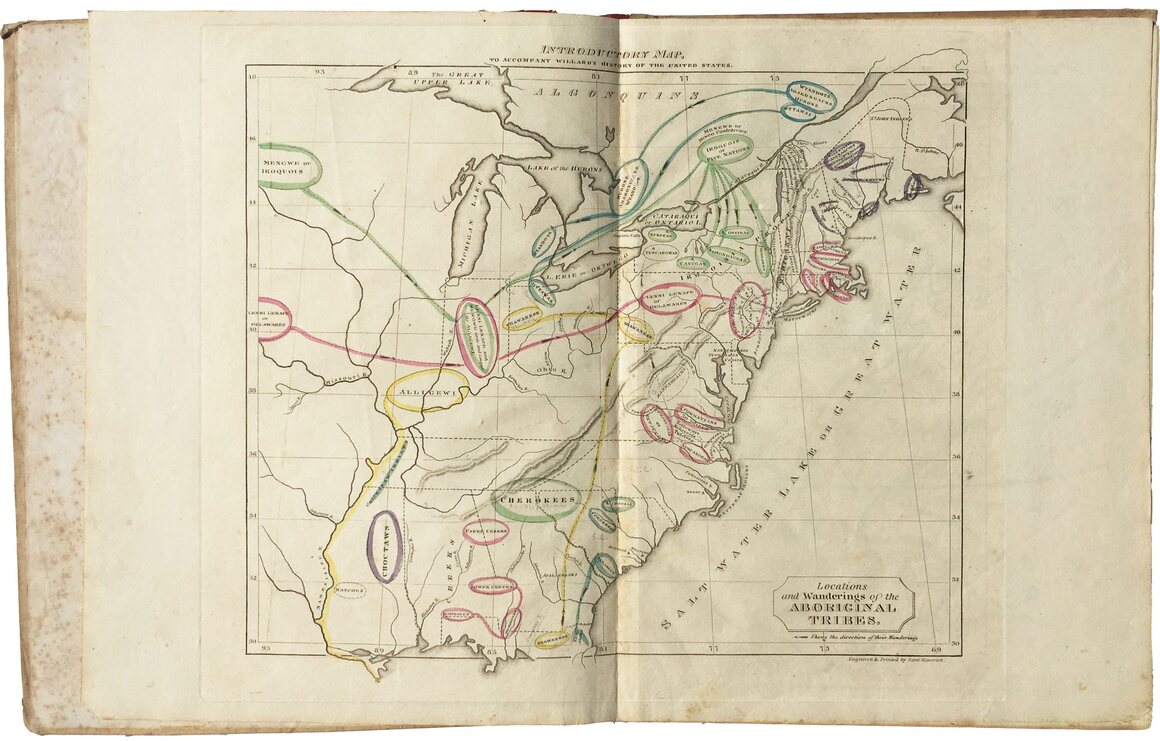
“She’s an exuberant nationalist,” says Susan Schulten, a historian at the University of Denver and the author of Mapping the Nation: History and Cartography in Nineteenth-Century America. “She’s extraordinarily proud of her country.”
It’d be wrong to call Willard a feminist, but she believed in the intellectual potential and education of women. At the time, education for girls was limited to certain “softer” subjects—geography among them—but Willard knew that girls could tackle philosophy and natural sciences with as much rigor as boys. Before she was 20, she was running a school; before she was 30, she had founded her own. Her school was the first in the country to educate woman at a college level, and Willard’s textbooks were some of the best-selling in America.
But her maps were among her greatest innovations. At the time, as Schulten writes, “Americans discovered that maps could organize and analyze information.” Willard believed that maps should capture information about the sweep of history, a story that unfolded across time and space. She created maps as a pedagogical tool, with the idea that an image could help cement lessons in the minds of her students. (She believed, like most educators of her time, in the power and precedence of memorization.) Her historical atlas was one of the major and influential results of these efforts.

In all, her atlas included 12 maps, though that number varies a little across editions. The one depicting the movements of tribes she called an “introductory” map, outside of historical time; American history, as she conceived it, began in the period from 1492 to 1578, when European exploration of the land across the Atlantic began. Each map that followed moved along the story of Anglo settlement and increasing control of American land, highlighting key events, from the Pilgrims’ landing at Plymouth Rock to the Treaty of Paris to the War of 1812, and culminating with the division of states at that time.
But that introductory map of tribal movements already hints at this ending. The boundaries of the future states are already there, in faint outlines. Even as she gave Native American peoples more attention than her contemporaries had, she helped to form a story that wrote them out of American history.
“She often framed the native tribes in terms of respect, sometimes as welcoming the colonists while other times as constituting a formidable obstacle; but more generally she accepted the removal of these tribes to the west as inevitable,” Schulten writes, in an article about Willard’s mapping of “settler society.”

After the first map, once “history” begins, the tribes appear only when they’re in conflict with or otherwise influencing Anglo-American society. In later versions of her historical atlas, Willard had illustrators depict Chief Powhatan as a “great-man-child” and other native people as stupified by European technology. Though it’s possible to imagine that Willard’s inclusion of tribal movements in her book represents a critique of settlers’ attitudes toward native people, ultimately her views are typical of Americans of her time: God meant for “civilized” people to take this land from “savages.”
What’s innovative about Willard’s work, cartographically speaking, is the way she tried to represent time. “Even though she sees it as inevitable that natives will disappear, she’s collapsing centuries onto a single image,” says Schulten. “She’s trying to map time in a different way as a prelude to what comes next. It’s really an argument that has everything to do with Anglo-America’s vision of the country. She’s a pioneer in that respect.”
The people’s verdict on capitalism is damning. 65% of Brits and 58% of Americans believe in capitalist economies the poor get poorer and the rich get richer. The gaping chasm between executive and worker pay appears to prove the point. And there’s little evidence to show sky-high pay is linked to stellar performance.
A decade on from the financial crash, the visible failure of too many businesses executives to show humility, and business owners to rein in obscene pay packets has left ordinary people questioning what capitalism has to offer them.
Executive pay is out-of-control
In 1965, CEOs of major US companies earned twenty times that of a typical worker. Just twenty years later they earned 59 times more.
In 2007, immediately before the financial crash, the ratio was a staggering 345 to one.
While the crash led to some adjustment, CEO pay remains 276 times higher than that of workers1.
The UK has followed a similar, though somewhat less extreme, trend. In 1980, CEOs were paid between 13 and 44 times their average employee, by 2013 FTSE 100 bosses earned around 130 times the average worker2.
 EPI
 High Pay Centre
It is not hard to see how a proposal by Britain’s hard-left Labour leader, Jeremy Corbyn, for top pay to be capped at twenty times the wage of a company’s lowest paid worker could find support among 57% of the British public3. While the average CEO pay package was almost £5.5 million in 2015, just a quarter of the FTSE 100 companies were accredited as Living Wage employers – committed to paying a minimum £8.45 an hour in the UK4. In America, 50% of the public favour limiting the pay of big business executives5.
Growing disparity can be observed across developed nations, but America’s pay gap, and to a lesser extent Britain’s, are particularly acute. Contrary to popular argument, it is not because the market for CEOs is so fierce – analysis by the High Pay Centre of appointments in the Fortune 500 found over 80% were internal promotions. And University of Delaware Research found internal promotions were higher performers6.
In fact, other countries have managed without resorting to such excess. An internationally comparative measure is compiled by Bloomberg, with America and the UK topping the list for developed nations7. By this measure bosses in America make 300 times that of the average person, while British bosses earn 230 times as much. The ratio for Australia is 113 to one, in France it is 70:1 and in Denmark 83:1, clearly showing that sky-high pay is not a prerequisite of capitalism, but rather a feature of particular market models. Models that have lost the faith of the public.
The rise of share options as part of executive compensation is one reason for this disparity. Already large CEO pay packets in American and UK firms have risen in line with stocks, widening the differential between the pay of executives and their subordinates8. American CEOs are particularly likely to have these incentives compared to their European counterparts. Weak corporate governance is another factor, with European firms more likely to experience closer scrutiny from creditors and independent boards. In contrast, American firms are more likely to combine the CEO and Chairman role, plainly undermining the independent scrutiny function of the board9. Harvard Law School found that as well as being an “inherent conflict of interest”, having a combined CEO/Chairman costs more, presents greater risk and delivers lower stock returns over the long term10.
If the reputational and ethical reasons for pay restraint are insufficiently compelling, investors should consider the findings of Morgan Stanley Capital International’s analysis of company pay11. On average, companies with lower pay gaps (smaller than the sector average) performed better than those with high gaps (higher than average). The report’s findings are tentative, but MSCI suggest some possible reasons for this: employee cost-saving initiatives exacerbate the pay gap without necessarily improving profitability, and executive remuneration is often tied to short-term performance and lacking independent checks and balances.
Executives are abusing their power in setting their own pay
It is executive (abuse of) power rather than performance that has driven pay, and absentee shareholders and poor corporate governance has let this happen. The MSCI study found 54% of companies lacked fully independent compensation committee oversight. Research by Harvard Law School clearly shows the cost of poor governance: a separate CEO and chairman model costs 75% of what a combined CEO/chairman costs. Even more tellingly, a separate CEO and with independent chairman, someone who has no current or former business relationship with the company, is even cheaper, with the CEO and independent chairman both making less12.
Shorty after the crash, Lord Myners, then a Minister in the UK Treasury and himself a former banker, criticised shareholders for behaving like “absentee landlords”, abdicating their responsibilities to challenge pay and behaviour. The madness of a business owner allowing their staff to set their own pay is obvious to most, yet despite the so-called “shareholder spring” this year, few FTSE 100 businesses have lost votes on pay.
Shareholders should think again. Analysis by Marianne Bertrand and Sendhill Mullainathan found that in companies with poor governance, CEOs typically pay themselves more for improvements in profit which arise from luck. They are also more likely to award themselves stock options at lower cost. Adding a large shareholder to the board led to a sizeable reduction in pay for luck, for example, by 23-33%13.
The relationship between pay and performance is broken
Ironically, in a model where compensation is increasingly linked to stock value, the rewards senior bankers receive bare little relation to sustained performance. Instead, incentivising short-term profit maximisation leads to reckless behaviour of the sort that brought about the financial crisis.
Recruiting and keeping talent is core to any business, and generous pay packages are one way of competing for the best. ‘Star’ traders in particular are coveted by financial institutions who believe their individual brilliance will deliver millions in profits. Todd Edgar, for example, was reportedly enticed to move to Barclays from JP Morgan with a two-year £30 million cash and shares package for him and his team.
But star performance is often about more than the individual. One study looked at the performance of ‘star’ investment analysts when they transferred from one bank to another14. Rather than justifying their sky-high pay packages through improved company performance, 46% of those so-called stars performed worse in the first year, generally by around 20%. And far from being a transitional blip, performance was still lower after five years. On top of that, the study found hiring stars had a negative effect on a company’s stock price. The authors are clear: “companies cannot gain a competitive advantage by hiring stars from outside the business”. Yet firms are competing for these ‘masters of the universe’, driving pay packages that are more and more extravagant.
There is no reason to think this hubris is confined to the financial sector, though the pay packages there are the most extreme. The authors of the ‘stars’ study extended their analysis to look at twenty top General Electric managers who took up top jobs elsewhere, finding similar problem with the portability of stardom15.
Tellingly, another academic paper found that when new CEOs are appointed and paid less than standard for the industry and company size, share performance is roughly average. But when CEOs are appointed on above average packages, they deliver lower returns: “excess pay appears significantly negatively linked to forward profitability”16.
Capitalism works when it benefits the majority. When wealth creation appears to accrue to an elite few, capitalism appears not as a force for good, but a force for greed. Gordon Gekko writ large. The financial crash vividly exposed the “fat cats” as undeserving of their sky-high pay and that their high pay encouraged them to act unwisely. Their reckless behaviour cost millions of ordinary people their jobs, homes and life savings. And yet a decade on, the gap between executive pay and the wages of ordinary workers is almost as wide as before the crash. If public faith in capitalism is to be restored, the connection between pay and performance must also be restored. Executive pay must be brought under control. Capitalists must themselves end the era of the undeserving rich.
This article is the first instalment in a three part series on the challenges facing capitalism. The second part will be published tomorrow.
The aspidistra, in Orwell’s novel, is an icon for lower middle-class values, as well as representing the surrender of the pathetic and unlikeable pseudo-Marxist protagonist to those values.
In our Barnet garden we have lemon trees and chilli bushes and geraniums and broad beans, but (metaphorically) towering above them all is the aspidistra. Nice people live here, our aspidistra signals. Yes, they do, our neighbour’s plant replies. Could you keep your voices down? comes the murmur from next-door-but-one.
Nice people live here. Quiet, suburban nice people, who don’t spit on the street, sodcast on buses, or require access to illegal drugs. Who give up their seats on the tube, and frown at loud and public swearing. Nice people who are disgusted at Cambridge students’ rejection of Remembrance Day, who are reflexively but unshowily patriotic, who wouldn’t dream of having a tea-towel with the Queen Mum’s face on it, but who are able to enjoy a Royal wedding without the need to simulate irony. Whose lips curl in distaste when yet another Left-wing comedian signals his horror at finding himself in a cab driven by a Brexit voter.
The lower middle-class aren’t the sole guardians of public civility and private decency, of course; we’re the close comrades of the ‘respectable working classes’, since most of us have parents or grandparents who originated there. My grandmother was in service. My parents worked shifts and open-before-dawn shops, so that I could have the luxury of university.
From birth, these people inhale the aspidistra law: you’re not fashionable. You are the butt of the joke. Oh, and you pay for everything that the oligarch spivs slide out from funding, either through your income tax or through corporation tax, whose bounty for the Exchequer is financed by your labour.
While the country depends on you, its elite will deride you: seared in my mind is Jonathan Miller’s hatred of Thatcher, her “odious suburban gentility and sentimental, saccharine patriotism, catering to the worst elements of commuter idiocy”. Those idiot commuters, those suburban patriots – that’s my class Dr Miller was sneering at; I’ll take our values over his any day.
So I cheered when Mrs May stood in Downing Street and said: “If you’re from an ordinary working-class family, life is much harder than many people in Westminster realise. You have a job but you don’t always have job security. You have your own home, but you worry about paying a mortgage.”
Further reading
By Peter Franklin
Maggie was back! I wrote an optimistic piece for ConservativeHome that urged Mrs May to use the aspidistra as the party logo and, well, to smash the cultural hegemony of our class enemies.
Rarely has my judgement been so wrong. Recent hate crime incident statistics, suggest that in “a trend that has now lasted several years”, British people have become more hateful to minorities in the wake of terrorist incidents. The inference is clear: we’re a panicky nation, ready to lash out spitefully at anyone who’s not the full Gammon, unable to differentiate between Islamic terrorists and people who aren’t.
Except, of course, these are hate crime “incidents”, not cases taken to court which result in a conviction. We know that police forces advertise widely to encourage people to report anything horrible, whether or not it’s a crime. Are we quite so horrible to one another as the newspaper headline and the Home Office commentary make out? I don’t mean that unpleasant people don’t say and do disgusting things. But are matters getting worse?
Not according to the Crime Survey, whose more reliable figures “indicate a drop of 40 per cent in hate crime incidents in the past decade.” To which evidential source would you give most credit? And how would an aspidistra government react?
Further reading
By Graeme Archer
An aspidistra Home Secretary – who’d probably look a bit like the current Attorney General – would address Parliament thus:
“I’ve no idea why police services waste money advertising for people to ring in with unsubstantiable complaints, and I’d recommend that voters signal to their Police and Crime Commissioner that they wish the practice to stop. The reliable Crime Survey indicates an overall continuing increase in the ability of British citizens to live well with one another. Of course, there are specific crimes whose existence we particularly abhor, such as acts of violence and intimidation against members of our religious communities, and these we will continue to prioritise and crack down on. We will investigate, for example, why Jewish communities require to have guards at their schools, and I’m pleased to announce today an enquiry into the worrying signs of religious extremism in the prison estate.”
What actually happened: the enquiry into prison radicalisation blocked. The hate crime ‘statistics’ were used as evidence that more hate crime laws covering more topics are needed.
At every opportunity to diverge from the New Labour approach to identity politics and its associated values, Mrs May has instead taken the opportunity to double down on it. The Gender Recognition Act is a particularly egregious example; not “How can we protect the dignity of transgender citizens?” (a worthy objective), but “Which lobby group’s policies should we implement wholesale, regardless of their connection to our values?”
Voters with working- and lower middle-class values aren’t automatically Tory; they can and do vote for any party: but the party which secures their support would be on to a winner. At the moment, such voters are completely unrepresented by the mainstream: the LibDems obsessed with Europe; Labour a disgusting mixture of hard-Left creeps and robotic Blairite leftovers. We looked to you, Mrs May. And you turned your back on us.
The Prime Minister’s failure to unwind the Blairite cultural settlement will be part of her political obituary, and the entirety of her political tragedy. The class enemies of working- and lower-middle class Britons are winning, still; that they are winning by default is all the more depressing.
Lobbying is big business, and, despite President Trump’s campaign pledge to “drain the swamp”, 2017 saw the highest spending on lobbying since 2010.
The top three spending industries according to the Open Secrets database were:
Some people have pointed to Donald Trump’s harsh rhetoric on drug pricing to explain the pharmaceutical industry’s eye-watering spend ($30 million up on 2016). During his first press conference as president-elect he described the industry as “getting away with murder”.


You must be logged in to post a comment.